
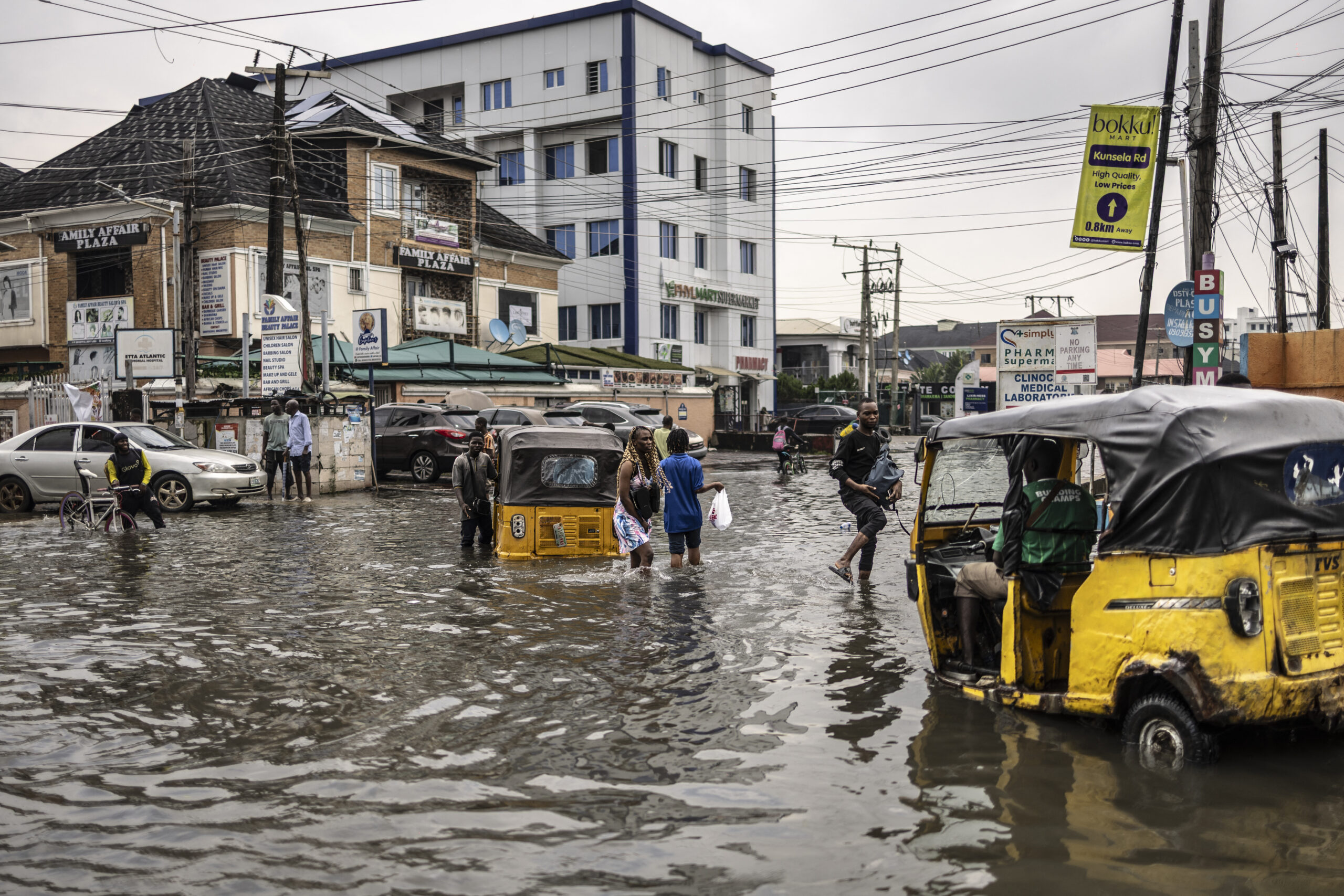
Between June and September every year, flooding becomes one of the defining features of urban life across West Africa’s coastal cities. Roads disappear beneath water in Lagos, businesses close across Accra, families are displaced in Abidjan and governments once again declare emergencies that have become almost routine. The scale of destruction continues to grow. Nigeria’s 2022 floods alone affected more than 3.2m people, displaced 1.5m and claimed over 600 lives.
Climate change has undoubtedly intensified this crisis. Rainfall has become heavier and more concentrated, while rising sea levels continue to increase the exposure of coastal settlements. Yet climate change alone cannot explain why, despite decades of evidence, planning and investment, the same cities continue to flood in the same places every year. Long before the first storms arrive each rainy season, meteorological agencies issue warnings and identify high-risk communities. The hazards are anticipated with remarkable accuracy, yet the devastation remains consistent.
The answer lies not simply in the climate, but in the political and financial systems that continue to reward responding to disasters more readily than preventing them.
Policy failures collide
The annual floods that overwhelm West Africa’s coastal cities are often described as natural disasters. Increasingly, they are better understood as systems failures. It is the interaction between weak planning, inadequate infrastructure, poor waste management and ineffective governance that determines whether heavy rain becomes a humanitarian and economic crisis.
The evidence is remarkably consistent across the region. Lagos has lost almost all of its wetlands, one of its most effective natural flood defences, while generating around 13,000 tonnes of waste each day through a waste management system that continues to leave drains clogged and communities increasingly vulnerable to flooding. In Accra, floods have also persisted because the Odaw River and Korle Lagoon basin, which drains almost 60% of the city, has become one of the most polluted urban water systems in the world, despite the World-Bank-backed $285m Greater Accra Resilient and Integrated Development (GARID) Project.
This has far-reaching consequences beyond the environment. Studies consistently identify blocked drains and unmanaged solid waste as the principal drivers of flooding, contributing not only to property damage but also to repeated outbreaks of cholera and malaria in lower-income communities.
The real shortage is not money
Africa receives only around $10bn annually in international adaptation finance, against estimated needs of roughly $100bn a year. The continent undoubtedly needs significantly more adaptation finance, but the evidence suggests that money alone is not the principal constraint. The more fundamental challenge is that public finance, political incentives and private investment continue to reward responding to disasters far more consistently than preventing them.
Nigeria’s Ecological Fund illustrates the contradiction. Created in 1981 to finance environmental risks, Nigeria’s Ecological Fund received more than 548bn naira ($397m) between 2012 and 2021. Yet audits have revealed funds diverted to unrelated priorities, with high-profile corruption cases involving state officials. Even the resources that do exist remain difficult to track because resilience spending is often buried within broader infrastructure budgets, making accountability almost impossible.
Perhaps these competing priorities are nowhere more visible than in the way resilience itself is financed. Lagos’ Eko Atlantic development has become one of Africa’s most ambitious privately financed coastal projects, protected by an 8.5-kilometre sea wall engineered to withstand extreme storm surges. Yet it also raises uncomfortable questions about whose resilience receives that level of commitment.
While billions have been invested in protecting high-value coastal assets, many lower-income communities remain dependent on overstretched drainage systems, inconsistent waste collection and emergency relief after each flood. The contrast reflects a broader pattern in which resilience is often strongest where economic value is highest, rather than where vulnerability is greatest.
Solutions exist – time to scale
West Africa already has examples of what effective climate resilience can look like. In Senegal, the $80m Saint-Louis Emergency Recovery and Resilience Project, delivered through the World Bank’s West Africa Coastal Areas (WACA) programme, relocated over 15,000 people from high-risk coastal erosion zones, showing that governments can invest in reducing risk before disasters strike.
The challenge is no longer identifying solutions but scaling them. Lagos has already identified roughly $9bn in resilience investments through its Climate Adaptation and Resilience Plan, but less than 2% of adaptation finance currently comes from private sources. Closing that gap will require governments to treat resilience as core economic infrastructure, while creating clearer pathways for private capital to invest in local adaptation priorities such as drainage systems, waste management and nature-based solutions.
Regional platforms such as WACA already provide the architecture to mobilise concessional finance and de-risk these investments. The next step is using concessional and philanthropic capital more strategically to absorb early-stage risk, making resilience projects sufficiently bankable to attract commercial investment at scale.
The cost of maintaining the status quo will extend far beyond increasingly severe floods. The World Bank estimates that environmental degradation already costs Benin, Côte d’Ivoire, Senegal and Togo $3.8bn annually, while climate pressures could displace up to 32m people across West Africa by 2050 if current trajectories continue.
The greatest risk, however, is that these outcomes become accepted as the inevitable cost of urbanisation and climate change. They are not. If nothing is done, the cities driving West Africa’s economic future will become progressively harder to insure, more expensive to invest in and increasingly unequal places to live. By then, the question will no longer be whether these floods were predictable. It will be why, despite knowing exactly what was happening, so little was done to prevent them.
Sekinat Ojeniyi is a senior consultant at Africa Practice