
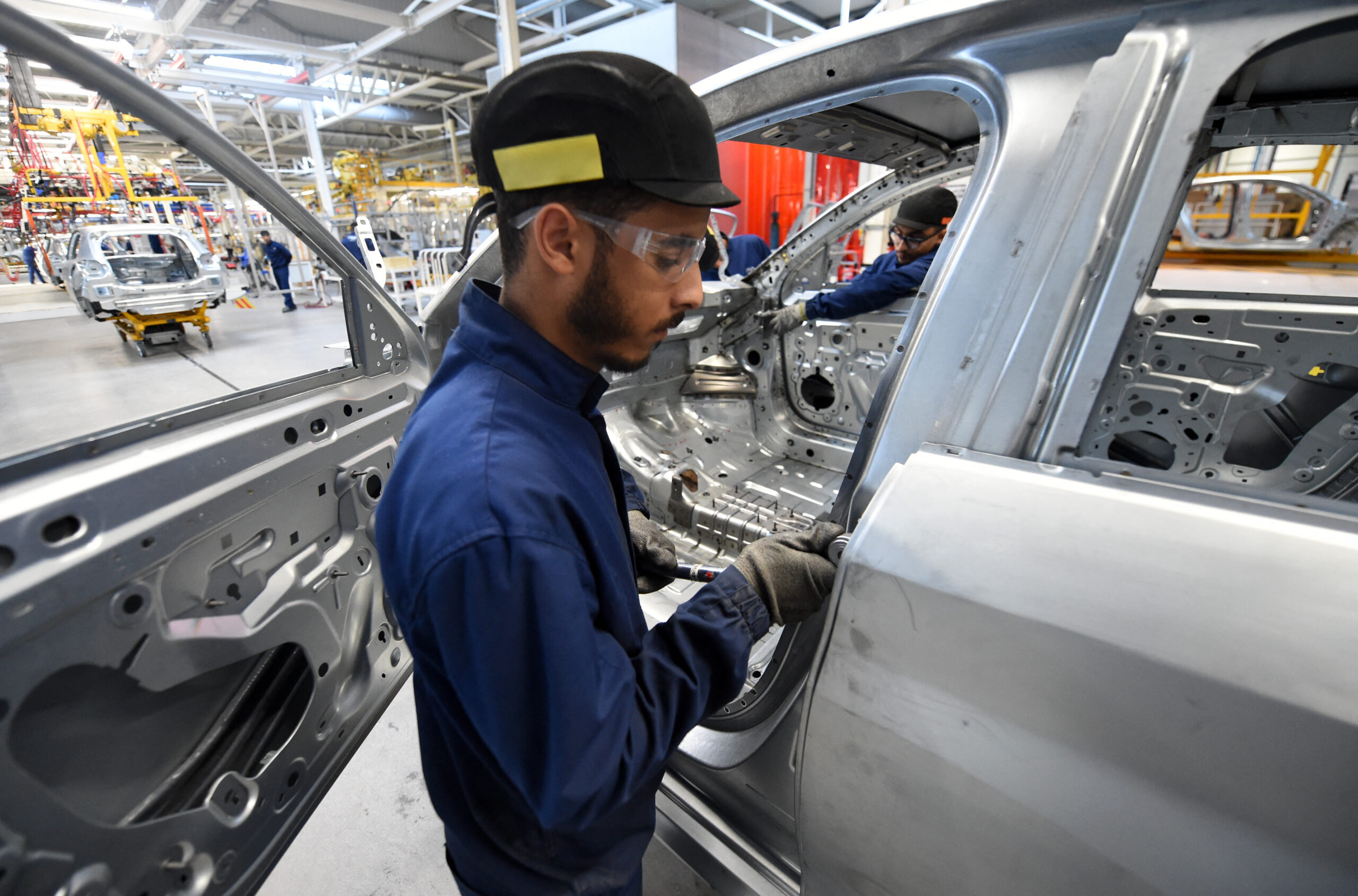
In June 2024 China’s Gotion High Tech, a major manufacturer of lithium-ion batteries, announced a $1.3bn investment to build Morocco’s first electric vehicle (EV) battery “gigafactory”. In a deal signed with the Morocco government, Gotion High Tech agreed to construct the factory with an initial battery capacity of 20 gigawatt hours (GWh), with the ultimate ambition of building a $6.5bn, 100 GWh factory – making it one of China’s most significant manufacturing projects in Africa.
This investment deal is symbolic of a much broader deepening of political and economic relations between Beijing and Rabat. In 2024, the total volume of China-Morocco trade surpassed $9bn, making China the North African country’s third largest trading partner in the world. Trade then rose again in 2025 to just under $11bn – an increase of over 20% in a single year.
While Morocco imports a variety of goods from China – with Beijing becoming a key exporter of products including electronics, industrial equipment, vehicles and plastics; and more modest volumes of goods such as copper and minerals heading in the other direction – the relationship has now evolved beyond trade alone, with Chinese companies pouring billions of dollars into Morocco’s automotive and manufacturing sectors.
As well as the Gotion High Tech deal, in 2024 Chinese auto battery manufacturers Hailiang and Shinzoom announced similar plans to set up two separate plants near Morocco’s northern port city of Tangier. Hailiang’s factory is designed to produce copper, with Shinzoom setting up in Tangier to produce anodes – two vital materials for EVs.
In March 2024 the Moroccan government approved a deal for another Chinese battery producer, BTR New Material Group, to build a new factory near Tangier to produce cathodes, another key component for EV batteries. The Chinese company pledged to commit $300m to the building of the plant.
In June 2025 a Sino-Moroccan joint venture called COBCO started producing other materials needed for the lithium-ion batteries that power EVs – namely nickel-manganese-cobalt (NMC) precursors and precursor cathode active materials (pCAMs).
The $2bn facility in Jorf Lasfar, south of Casablanca, aims to achieve a total annual capacity equivalent to 70 GWh, which could supply battery packs for about one million EVs.
Raw materials attraction
Morocco has become increasingly popular for Chinese companies in the EV and batteries space. This is partly because the North African country is home to vital raw materials: Rabat is the world’s largest exporter of phosphate rocks, for example, with some estimates suggesting that up to 80% of global reserves are in Morocco. Phosphate is used to produce lithium iron phosphate batteries for EVs.
Bob Savic, head of international trade at the Global Policy Institute in London, tells African Business that “China’s rising engagement in Morocco and the wider Middle East and North Africa (MENA) region is driven by considerations around energy security – the need to secure oil and gas from the Gulf and certain North African states, in addition to expanding renewable energy ventures – as well as export markets for infrastructure and technology, and geopolitical hedging against rising Western hostility to Chinese industrial and trade growth.
“Additionally, the neutral or China-friendly stances of MENA countries on issues like [the treatment of Uyghur people in] Xinjiang and [the status of] Taiwan make it an attractive region for Beijing to set up long-term economic and political partnerships,” Savic says. “Post-Covid supply chain diversification and access to Africa via Morocco’s logistical hubs are also key strategic pulls.”
EU’s auto concerns
While Chinese investment into Morocco has become increasingly important to Rabat’s economy, there are growing concerns that this could impact ties with another vital partner, the European Union (EU). Brussels is Morocco’s single largest trading partner, with more than a third of its exports heading to Europe.
China’s massive investment in Morocco’s automotive industry has raised eyebrows in Brussels, with some officials suspecting that Beijing is using Rabat as a way to circumvent European tariffs. The EU has taken significant steps to protect its domestic auto manufacturing – including a baseline 10% import duty on all vehicles – with special measures aimed at ensuring European manufacturers are not undercut by cheaper competitors from China, many of whom are subsidised by the Chinese state.
In October 2024 the EU approved a range of anti-subsidy tariffs on Chinese EVs. The specific additional tariff, on top of the baseline 10% rate, varies by company: BYD, for example, is subject to a 17% tariff and SAIC up to 35%. In June it was reported that the European Commission is preparing further duties on Chinese vehicles.
Part of Morocco’s attractiveness to international companies, including those from China, is that Rabat has over 50 free trade deals, including deals with the US and the EU. EU trade commissioner Maros Sefcovic has warned of the risk of “transshipment” into the European market, which he also said is becoming a “big, big issue for the European economy”.
Savic says that it is an “oversimplification” to suggest that China is using Morocco merely as a way to circumvent European tariffs. “While access to EU and US markets via Morocco’s free trade agreements is a clear economic incentive, deeper drivers include Morocco’s political stability, modern infrastructure and convenient proximity to southwestern Europe.”
“Morocco also offers access to African markets through the African Continental Free Trade Area (AfCFTA), so the relationship is mutually strategic, not just a tariff loophole.”
Time for tariffs?
But the EU has consistently demonstrated that it is not shy to impose tariffs on its partners – including in Africa – when it believes that it is necessary to defend European competitiveness. For example, in January this year the EU’s Carbon Border Adjustment Mechanism (CBAM) came into force – a tax on carbon-intensive goods that are imported into Europe that, in Brussels’ view, is needed to ensure that European manufacturers are not undercut by rivals subject to less stringent environmental standards.
Savic suggests that the EU may consider targeted measures against Morocco to protect against the risk of Chinese firms avoiding tariffs via Rabat; but he is sceptical that more wide-ranging measures against the country would be under consideration.
“The EU may impose anti-circumvention duties if it finds clear evidence of Chinese firms simply re-labelling or minimally processing goods in Morocco to evade EU tariffs, such as on EVs or solar panels,” he tells African Business.
“However, a broad tariff response is unlikely unless the practice becomes systematic and damaging to European industry. If the EU acts, it could strain EU-Morocco relations, as Rabat values its advanced economic and political status with the EU. Morocco might then deepen ties with China and Turkey as a hedge,” Savic adds. “Still, both sides have strong incentives to manage disputes diplomatically, given mutual interests in migration, counterterrorism and trade.”
Rabat’s juggling act
Part of Morocco’s economic success in recent years has depended on its ability to manage a range of diplomatic partnerships and avoid being drawn into taking sides on controversial geopolitical disputes.
Zakaria Hanafi, director of the Moroccan Center for Geopolitical Analysis and Anticipation in Rabat, previously told African Business that this approach is a critical part of Morocco’s economic development goals. “We have very good diplomatic and economic relations with everybody – with Russia, with China, with the US, with the UK, France and Germany,” he said. “This stability is very important not only geopolitically, but also economically.”
The coming years will test whether Morocco’s growing status as a hub for Chinese investment in North Africa can coexist with its deep economic ties to Europe – or whether Rabat will face some harder choices.