
The success of Africa’s textile and apparel industry under the United States’ African Growth and Opportunity Act (AGOA) is something of a double-edged sword.
Since its introduction in 2000, duty-free access to the vast US market enabled by AGOA has attracted significant foreign investment, most of it from Asian manufacturers, into countries across the continent.
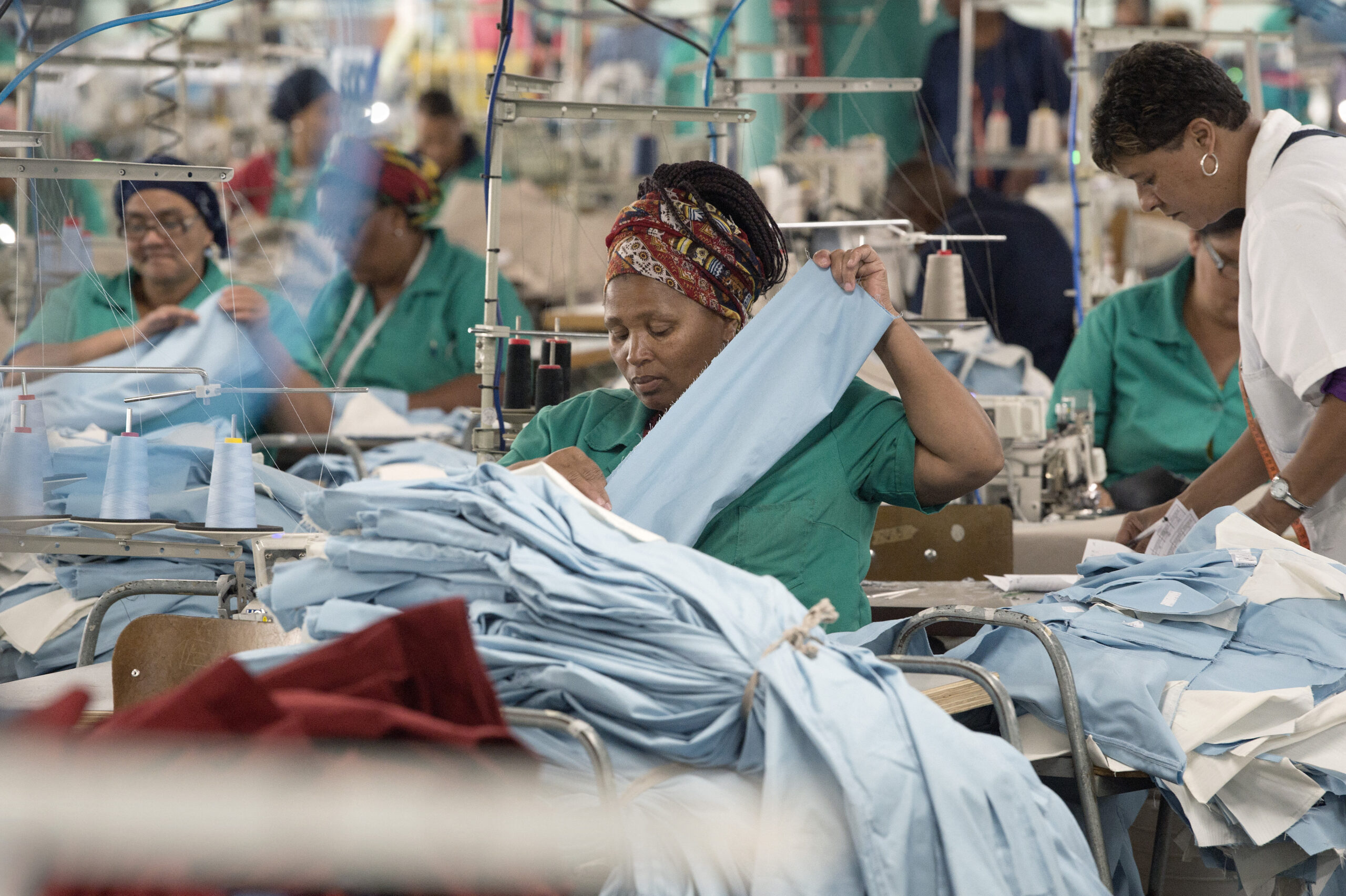
New factories have been established, export industries have flourished and hundreds of thousands of jobs, many of them for women, have been created. Modern production facilities now supply some of the world’s largest clothing retailers and brands, transforming several African economies into important apparel exporters.
Yet while AGOA has stimulated investment, employment and exports, it has largely failed to build the vertically integrated textile industries that many African governments had hoped would emerge.
Third country controversy
The main reason for this lies in one of AGOA’s most important provisions: the third country fabric provision. This allows eligible countries to export garments to the US duty-free even when the yarn and fabric are imported from outside Africa.
The provision has been instrumental in the industry’s success. By allowing manufacturers to source competitively priced textiles from Asia – particularly China, Taiwan, South Korea and India – it significantly reduced start-up costs, shortened supply chains and enabled African producers to compete in the highly price-sensitive global apparel market.
But because manufacturers could rely on imported inputs while still qualifying for AGOA preferences, there has been little commercial incentive to invest in upstream industries in the value chain within Africa.
As a result, many countries have developed strong garment assembly industries but remain heavily dependent on imported fabrics and accessories, capturing only a fraction of the value generated across the global supply chain.
This dependence has also made the sector in Africa more vulnerable. Uncertainty over AGOA’s future has exposed how reliant many African apparel exporters remain on a trade preference over which they have little control.
This raises questions about the long-term sustainability of these industries, particularly given question marks over AGOA’s own survival.
South Africa illustrates the importance of the third country fabric provision from the opposite perspective.
Although it has been one of AGOA’s largest beneficiaries overall, accounting for more than half of the programme’s non-oil exports to the US, it was excluded from the third-country fabric provision because of its higher level of economic development.
As a result, South Africa has not developed a significant apparel export industry under AGOA, and its textile sector has never properly recovered from the damage done when the highly protected industry was opened up to international competition after the end of apartheid.
Building export economies
The biggest beneficiaries of AGOA’s textile preferences have been Kenya, Lesotho, Madagascar, Ethiopia, Mauritius and Eswatini. Together they have built globally competitive apparel export industries, attracted billions of dollars in investment and created hundreds of thousands of jobs.
The foundations for this investment were laid well before AGOA. The first wave of investment was driven by the internationally agreed Multi-Fibre Arrangement (MFA), which imposed export quotas on rapidly industrialising Asian producers to protect textile manufacturers in developed countries from the 1970s through to the 1990s.
Because many African countries had little or no quota utilisation, they became attractive production bases for Asian manufacturers seeking access to lucrative Western markets.
Taiwanese companies were among the first to seize the opportunity, establishing factories in countries including Lesotho, Eswatini and Kenya. When AGOA came into force in 2000, they already had a manufacturing footprint in Africa and quickly shifted production to take advantage of duty-free access to the US.
The dismantling of the MFA in 2005 exposed Africa-based manufacturers to direct competition from Asia. By then, however, AGOA had become the new engine of growth.
Lesotho became the programme’s standout success story. Tens of thousands of workers, most of them women, produced jeans, T-shirts, knitwear and workwear for global brands including Levi Strauss, Wrangler, Gap and Walmart.
Eswatini benefited from similar investment, while both countries leveraged their proximity to South Africa and membership of the Southern African Customs Union to strengthen regional supply chains.
Kenya set up export processing zones, creating more than 60,000 direct jobs and attracting more than $700m in investments.
Madagascar, which began building a textile industry in the 1990s to benefit from trade preferences with Europe, ramped it up on the back of AGOA. However, its industry was rocked by the withdrawal of AGOA eligibility in 2010 after a military coup, resulting in massive job losses and factory closures. It was able to rebuild from 2015 when it regained eligibility.
Ethiopia represented a second generation of AGOA-driven investment. Under an ambitious industrialisation strategy, the government established dedicated textile and apparel parks, most notably Hawassa Industrial Park, developed in partnership with global apparel giant PVH Corp, owner of Calvin Klein and Tommy Hilfiger.
The strategy aimed not only to assemble garments but also to develop local cotton production and textile supply chains. Those ambitions were abruptly interrupted when Ethiopia lost AGOA eligibility in 2022 following the conflict in Tigray.
Vertical integration questions
The greatest weakness of AGOA is that it created export industries without creating textile industries.
Most beneficiary countries specialised in cut-make-trim (CMT) manufacturing, importing yarn, fabric and accessories from Asia, assembling garments in Africa and exporting them to the US.
The third country fabric provision made commercial sense as it reduced costs and enabled Africa to compete, but it also removed much of the incentive for foreign companies to invest in spinning, weaving, dyeing and finishing industries.
Regional textile value chains do exist in the sector but are relatively small. Cotton production in countries such as Mali, Benin, Cote d’Ivoire, Cameroon, Burkina Faso and Egypt as well as South Africa is mostly exported out of Africa.
Some of the biggest historical producers of cotton and associated value addition, such as South Africa, Zimbabwe and Nigeria, have seen these dwindle over time as a result of tariff liberalisation, unsupportive policies, and other issues.
Creating new textile models
Benin, a significant cotton producer and exporter, represents the new and more sustainable cotton-to-clothing model being forged for the textile sector in Africa.
Its strategy is to build efficient and sustainable vertical integration, starting with the Glo-Djigbé Industrial Zone, a public-private sector facility housing integrated plants designed to transform local cotton into finished knit apparel.
The MFA, AGOA and other preferences have offered significant benefits to African nations, but are also fraught with potential danger, creating an externally dependent model of industrialisation that is easily disrupted.
Countries can easily be stripped of their AGOA eligibility at any time, as happened with Madagascar and Ethiopia.
Uncertainty about the programme itself arose in the wake of the delay between the expiry of AGOA in September last year and the retroactive renewal of it in February 2026.
The renewal is just until December 2026 and what comes next is uncertain, raising risks for investment, contracts and supply chains.
Economist Carlos Lopes says programmes such as AGOA, by focusing on raw trade concessions without fixing systemic issues, are keeping African nations trapped in commodity dependence instead of driving true industrial transformation.
Analysts argue that the African Continental Free Trade Area is a better bet for sustainable industrial development. It is a permanent arrangement and is designed to build a unified internal market.
African Development Bank president Sidi Ould Tah says ongoing concerns about AGOA’s future and shifting US trade policies are catalysts for accelerating the African Continental Free Trade Area. More intra-African regional value chains are the only way African can build resilient and long-term industrial transformation, he notes.
AGOA proved that preferential market access can create industries, attract investment and generate employment. What it has not proved is that trade preferences alone can drive structural transformation.
Africa’s next challenge is not simply to export more garments, but to retain more of the value chain, from cotton and yarn to fabric, design and finished apparel.
This article is from a new series, from Cotton to Cloth, which explores Africa’s cotton opportunity in collaboration with Afreximbank.