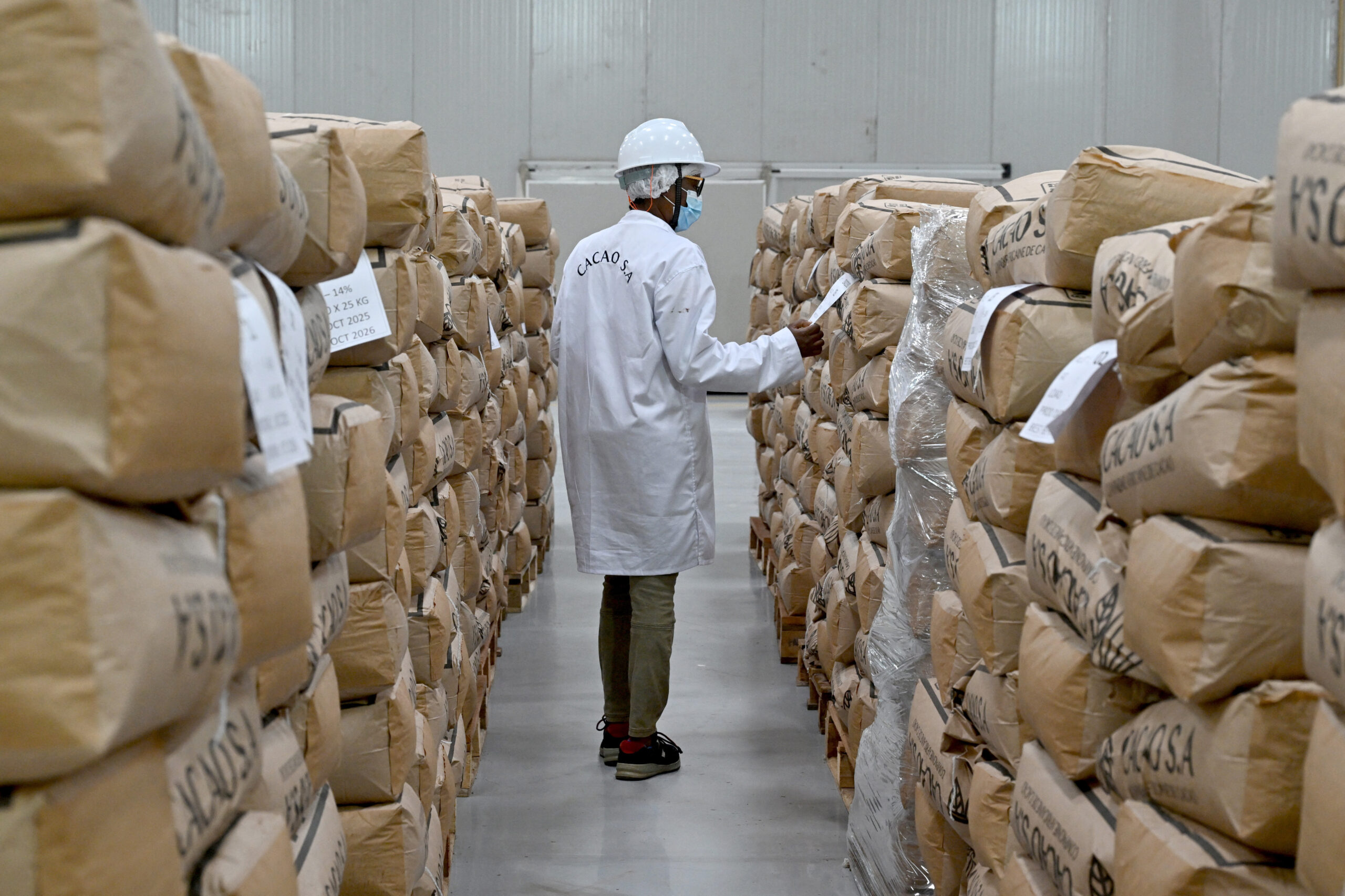
African cocoa exports to Europe are among the oldest established directional flows in the global commodities trade, accounting for more than two-thirds of the cocoa trade.
But with the start of China’s zero-tariff regime for African goods in May, exporters of the main ingredient in chocolate, are now looking east as they contemplate export expansion, according to industry officials.
For Côte d’Ivoire and Ghana, the two largest cocoa exporters, cocoa products entering China faced import tariffs ranging from about 8% to 22%, depending on whether the cocoa was exported in a raw or processed state. Those tariffs have now been removed under the new regime.
“The policy definitely is an incentive to increase exports of cocoa to China, which has a very large population,” Adeola Adegoke, president of the Cocoa and Coffee Farmers Alliance of Africa, told African Business.
“Europe consumes two-thirds of African cocoa but other markets are now emerging in China and India, and these are also competing.”
Production problems
West Africa accounts for more than 70% of global cocoa production, with the rest coming from South America and Asia. Four of the top five producers are in the region, including the leader, Côte d’Ivoire; second placed Ghana; and Nigeria and Cameroon, which occupy fourth and fifth places, respectively. Indonesia is the third-biggest producer.
The cocoa season, which runs from October to September, has two harvests. These are the smaller light crop, harvested between March and June, and the main crop that runs from October to December.
In recent years, African cocoa production has been hit by the vagaries of ageing trees in the top producers Ghana and Côte d’Ivoire, as well as erratic weather, leading to global output shortfalls and price volatility.
Following a brief production recovery in the 2024-2025 cocoa year, the main crop harvest suffered at the start of the 2025-2026 season, creating more supply uncertainties. Output is currently estimated at 4.368 million tonnes, a decline of 12.9% from the previous year, according to the International Cocoa Organization (ICCO).
Production fell to 1.6 million tonnes from 2 million tonnes in top producer Côte d’Ivoire and by as much as 500,000 tonnes or half in Ghana as a combination of disease and unstable weather took its toll. The US and Europe were the leading export destinations, followed by Malaysia, which has emerged as an important processing hub in Asia for chocolate makers in China, India and other countries in the region.
“Statistically, we are seeing emerging consumption in China and India,” said Adegoke. “China has put forward zero tariffs as an incentive, it is now on us to look at that incentive as a pathway to more gains.”
The value of China’s cocoa imports jumped from $714m in 2013 to $1.34bn in 2024, according to New York-based Trading Economics, an increase of 88%. Chinese buyers have already shown an inclination to import processed cocoa products.
Making chocolate in Africa
In the world’s biggest producer, Côte d’Ivoire, China has been involved in setting up two major cocoa-processing plants, undertaken by the China Light Industry Nanning Design Engineering Company (CLINDE). One is the 50,000-tonnes-per year processing plant in the PK24 Industrial Park, just outside the commercial capital, Abidjan; and the 100,000-tonne plant in the cocoa-trading port town of San Pedro.
In neighbouring Ghana, there is the FCL Processing’s 32,000-tonne per annum plant near the capital, Accra, also built by CLINDE.
In all the cases, the facilities were built with Chinese financing in a state-to-state partnership, with the objective of providing China preferential access to products such as cocoa butter, powder, cake, and other derivatives of the crop. Sometimes as much as 40% of the output is reserved for export to China, according to officials of Ghana’s agriculture ministry.
This potentially pitches Chinese interests against the old guard of the industry such as Cargill, Barry Callebaut, and Olam that have long dominated the global cocoa trade. The producer countries find the prospects of more value-added cocoa exports attractive and more partnerships with China are likely to expand domestic processing capacity.
In Nigeria, which produces more than 300,000 tonnes annually, Sunbeth Global Concepts, one of the country’s biggest exporters, is building a 50,000 tonnes per annum cocoa-processing factory in the town of Sagamu, north of the commercial capital of Lagos. The company exports to Europe and North America.
Sunbeth Global’s CEO Olasunkanmi Owoyemi told African Business that China’s zero-tariff has yet to influence the company’s business decisions.
“But that might change soon,” he added.
West Africa demands cocoa processing
The West African producers from Côte d’Ivoire, Ghana, Nigeria and Cameroon met in Abuja, the Nigerian capital, on July 16, where they signed a joint declaration to work toward more local processing of cocoa butter and powder while discouraging raw cocoa exports. Beyond local processing, they pledged to provide incentives for the local manufacture of chocolates and other chocolate products. The four countries account for more than two-thirds of global production.
Nigerian minister of state for industry, John Owan Enoh, said the declaration is a rejection of an inherited colonial trade structure that condemned Africa to shipping raw materials and buying expensive finished goods made with them.
“For a hundred years, Africa has sent its cocoa to the world in sacks and received it back in wrappers,” Enoh said.“We are not interested in exporting anonymous sacks anymore.”
The CEO of the Ghana Cocoa Board Ransford Abbey told reporters that African producers received only about $10-15bn of the value generated by the global cocoa-products industry estimated to be worth more than $130bn. European countries export more than $28bn of chocolate products annually, using cocoa imported from Africa, he said.
The four African producers will also adopt a common position in negotiations on the European Union Deforestation Regulations set to come into effect on December 30. It requires that all cocoa exported to the EU must be traceable to where it was produced to ensure it did not cause deforestation.
West to East?
Exports to China and other parts of Asia may provide an opportunity for African farmers to escape the stranglehold of big-time buyers from Europe, who have dominated the trade for decades, denying farmers access to the international market, according to Adegoke of the African farmers alliance.
Many cocoa exporters currently tied to European buyers by supply contracts will likely explore opportunities with China and other Asian countries where there is growing demand once their current contracts expire, industry officials said.
Still, for African cocoa farmers to make full use of emerging opportunities, there is an urgent need to boost productivity and yield, said Adegoke. Currently, West African cocoa farmers have an average yield of between 400 kilograms and 600 kilograms per acre.
“There’s a lot to be done in terms of enhancing our productivity,” he said. “If we can increase our productivity per acre to 800-900 kilograms, then there will be higher profit margins.”