Johannesburg – once celebrated as Africa’s economic powerhouse and the “City of Gold” – is now in a state of profound decline, according to business leaders, analysts, civic organisations and the National Treasury.
Although it remains South Africa’s financial and commercial hub, the city is marked by infrastructure collapse, municipal dysfunction, corruption, financial distress, violent crime and widespread urban decay. Its golden lustre has turned to rust.
Today Johannesburg’s population stands at almost 5m and it is one of the most diverse and cosmopolitan urban centres in Africa – a place shaped by migration, commerce, ambition and cultural fusion.
Here, South Africans live alongside large communities of people from Zimbabwe, Mozambique, Nigeria, the Democratic Republic of Congo, Ethiopia, Pakistan, India, China and many other countries, lending the city a distinctly international character.
The wealthy northern suburbs, bustling townships, inner-city districts and business nodes reflect sharp contrasts of class, language and cultures, yet together create an energetic urban culture driven by entrepreneurship, finance, music, fashion, art and nightlife.
‘A city in freefall’
But business leaders, analysts and civic organisations have issued increasingly stark warnings about Johannesburg’s deterioration, describing a city facing infrastructure collapse, governance failures, financial instability and declining investor confidence.
Critics of its administration warn that Johannesburg is teetering on the brink of financial collapse, amid concerns over unlawful expenditure and worsening debt. Johannesburg’s infrastructure backlog has exceeded 220bn rand ($13bn), according to Mayor Dada Morero, the tenth mayoral incumbent since 2016. Meanwhile, the city is losing 44.7% of its water through leaks, theft and damaged infrastructure, according to the auditor-general. Electricity losses have climbed to 27.1%. Residents, businesses and state entities owed the city about 71.9bn rand ($4.4bn) in unpaid bills by late 2025.
Kevin Allan, a local government expert and the managing director of Municipal IQ, a data and intelligence service that tracks and benchmarks all 257 municipalities in South Africa, says Johannesburg’s crisis has become “a national economic risk,” arguing that the city’s leadership is in denial about the sheer scale of the collapse.
He says almost every major indicator – infrastructure, finances and service delivery – is moving in the wrong direction.
Civic leaders send warning
Charismatic politician and entrepreneur Herman Mashaba, who is running for office as a representative of minority party ActionSA after serving as mayor of Johannesburg from 2016 to 2019, says the city’s municipal entities have been shackled by “layers of inefficiency and political interference”.
This, he says, is directly contributing to worsening infrastructure decay and unbearable financial strain.
Business and civic leaders have publicly warned that the city’s decay is now threatening its status as the country’s economic hub.
Julia Fish, managing director of JoburgCAN, an organisation that organises and empowers a network of community associations and businesses to ensure the responsible collection and use of rates and tax revenues, says Johannesburg’s decline is “the direct result of weak enforcement, inconsistent oversight and a failure to act”.
Zille links illegal building activity, hijacked buildings and collapsing infrastructure to years of governance failures.
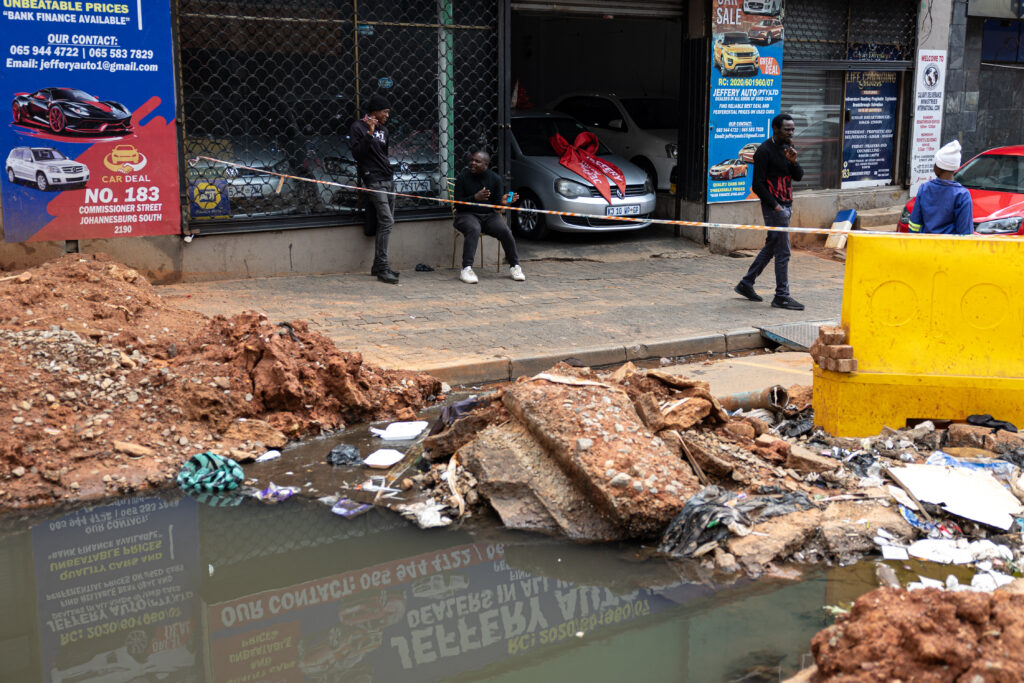
The signs of decay are evident across the city. Traffic lights fail for days or weeks at a time, and roads are riddled with potholes and sinkholes. Water outages regularly affect suburbs for extended periods, while electricity substations are vandalised or overloaded. Meanwhile, sewage spills into streets and rivers and illegal dumping and uncollected refuse are commonplace.
Busi Mavuso, chief executive of Business Leadership South Africa, says water failures and municipal mismanagement in Johannesburg are “threatening business continuity across sectors”.
She says the crisis is rooted in “sheer mismanagement”. International investors and multinational firms are also increasingly wary. A recent report in the Wall Street Journal says major corporations are reducing or ending their operations in South Africa due to “corruption, crime, poor infrastructure and government inefficiency”. Crime alone is estimated to cost the South African economy about 10% of GDP annually.
Homecoming for Zille
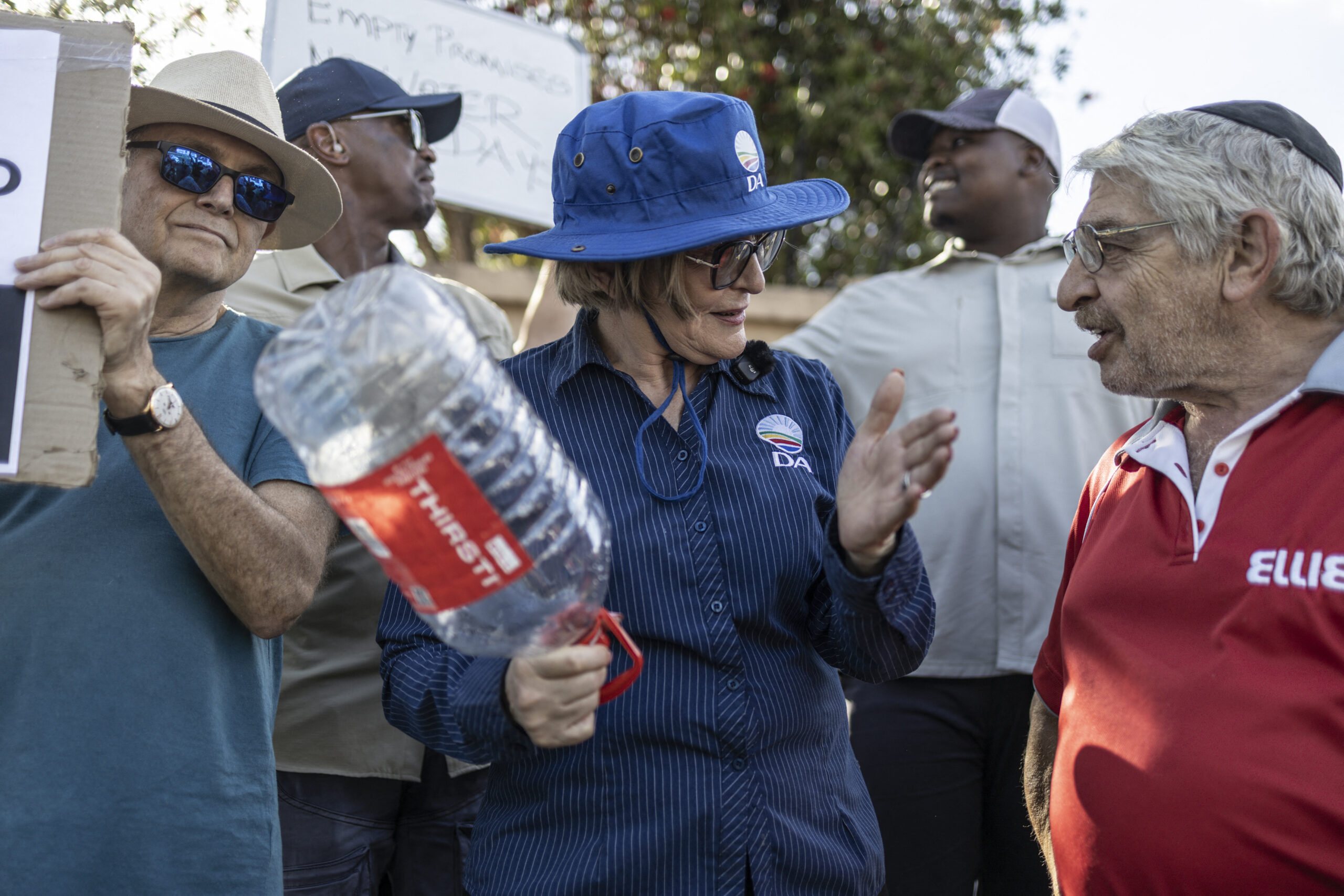
Enter Helen Zille, leader of the opposition Democratic Alliance (DA) from 2007 to 2015, mayor of Cape Town from 2006 to 2009 and premier of the Western Cape from 2009 to 2019.
At the age of 75, Zille is vying for the mayorship of Johannesburg, the city of her birth, in the country’s municipal elections on 4 November.
Zille began her working life as a journalist on the now defunct anti-apartheid newspaper the Rand Daily Mail. She has cultivated an image as one of South Africa’s most combative, forceful and polarising politicians.
Supporters view her as principled, competent and fearless in confronting corruption and state dysfunction; critics see her as abrasive and provocative.
Zille tells African Business that Johannesburg is “technically bankrupt. It has an unfunded budget and commitments that it cannot possibly meet. The minister of finance [Enoch Godongwana] has threatened to withhold its equitable share [of the national municipal budget], which would be a disaster for the city.”
Videos of Zille wading waist-deep through potholes – goggles and all – have gone viral and brought into sharp relief the degraded physical state of the city.
Zille says the entities responsible for service delivery have almost all been “an utter failure and are abused as funnels to siphon money out of the city through a range of corrupt dealings. They are not staffed by experts or professionals and, instead of being revenue generators they are a significant financial burden on the city.”
She tells African Business that although there are some good professionals in the city’s administration, “most of the senior employees are not fit-for-purpose and serve the ANC’s interests before those of citizens.
“For 30 years the city has neglected budgeting for adequate infrastructure maintenance and the infrastructure backlog is around 250bn rand [$15bn].”
Asked about the political reasons for Johannesburg’s decline, Zille says voters have failed to adequately hold the ruling ANC (African National Congress party) in the city to account. “Because the ANC achieved an overall majority again and again, they forgot about accountability, and used power to enrich themselves and their networks.
“The ANC, as a party, deployed its own cadres, who awarded tenders… in various corrupt business schemes.
“These cadres then rewarded ANC comrades in [national] government, as well as the ANC itself. Thus, the city’s administration slowly degenerated into a network of competing criminal syndicates,” she says.
Zille describes corruption in the city as “extreme”.

‘Extortion racket’
Zille says extortion, which is not only rife in Johannesburg but across all major urban centres in South Africa, is “a component of the corruption that has riddled and crippled the city”.
South Africa’s “construction mafia” and extortion syndicates have cost the construction industry more than 63bn rand ($3.8bn) in disrupted projects, sabotage, intimidation and delays since 2019, according to public works minister Dean Macpherson, who is a Democratic Alliance MP.
Gauteng – the province which includes Johannesburg – is the centre of the country’s construction economy and recorded the highest number of reported extortion cases.
Since late 2024 alone, authorities reported 745 construction-related extortion cases nationally, with Gauteng accounting for 241 cases, more than any other province.
Business groups and contractors have repeatedly warned that extortion in the city has stalled infrastructure upgrades, housing developments, logistics projects and public works contracts, adding billions in indirect losses through delays, higher security costs and cancelled investment.
Analysts and government sources indicate the losses run into many billions of rand per year.
Extortion-related violence has included assassinations of contractors, taxi operators, community activists, security personnel and business owners. However, because many killings are not officially tagged as extortion-linked, no authoritative annual death toll exists specifically for extortion murders in Johannesburg.
The city’s Metro police have a limited mandate: to enforce by-laws, to regulate traffic and to prevent crime. This underpowered entity cannot investigate crime, prepare dockets or drive issues through the court process, Zille says. It also has no mandate to undertake crime intelligence. Zille says it must be given new powers.
Zille says the one thing that has appalled her most after her recent return from Cape Town to the city of her birth is the extent of corruption.
Johannesburg, she says, “is a prime example of a criminal state”.
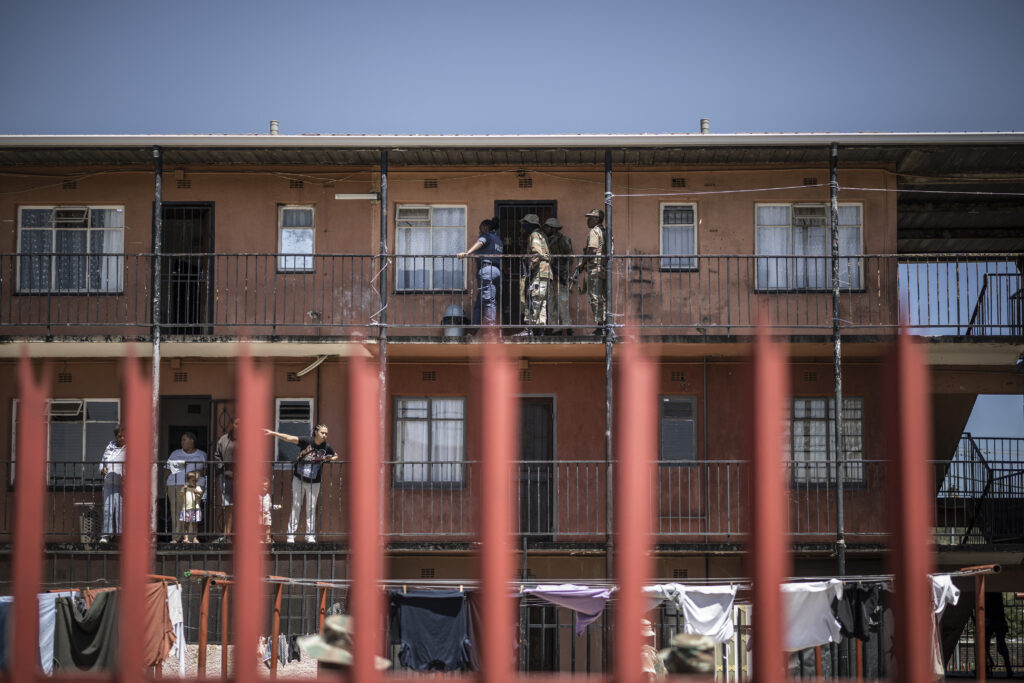
She says parts of the city have been captured by criminal networks and that, under her command, Joburg will be “wrestled back from a criminal mafia” – starting with the organised criminal syndicates that have deeply penetrated municipal entities. Investigations and audits will lay the ground for an assault on crime, she says.
Corrupt officials (“the heads of the snake”) will be fired, whistleblowers protected, and hijacked buildings reclaimed, she promises.
Zille unveils platform
Asked what other steps she would take towards getting the city back on its feet, Zille says: “The first thing we would have to do is formulate an adjustment budget. This will be a statutory requirement, and it cannot achieve much because one can only move 10% of revenue to new priorities.
“I will ask the minister of finance to deploy the specialist Johannesburg Task Team in the National Treasury to assist us, as they have built up a deep and extensive understanding of the various aspects of Joburg’s financial crisis.”
The infrastructure backlog and maintenance crises, Zille adds, “will be very difficult to address and would take years of prudent management to reduce… without even taking account of the need for extensive infrastructure expansion to make provision for this expanding city”.
Public private partnerships (PPPs) play a key role in her plans for rejuvenation of public services.
“City Power’s debt,” Zille says, “is about 19bn rand [$1.2bn]– the highest level of debt of any of the city’s entities. This can only be managed if City Power becomes a private-public partnership in which the debt is converted into shares in a company under professional private management.
“I would also partner with the Utilities Reform Programme, which is part of Operation Vulindlela [a joint initiative of the presidency and the National Treasury] – which offers significant financial incentives to ringfence funding for trading services [water and electricity]. And we would certainly ringfence most of this revenue.”
Bringing back business
Asked about the overall state of business in Johannesburg, Zille says the core problem is a lack of confidence in the future of the city. “This drives away investment and encourages existing businesses to relocate to more conducive locations.”
Zille has pledged to attract 200,000 new jobs to Johannesburg over five years by restoring municipal competence and improving service delivery.
She says functional infrastructure attracts investment, and revived business districts stimulate economic activity. She says business confidence cannot return unless Johannesburg provides dependable water, electricity, roads and traffic management.
But Zille says there will need to be to be a political and cultural deep-clean if the city is to once again attract capital.
Johannesburg, she says, “shows that where there is no respect for the crucial separation between party and state, it results in the collapse of professionalism in the public service”.