
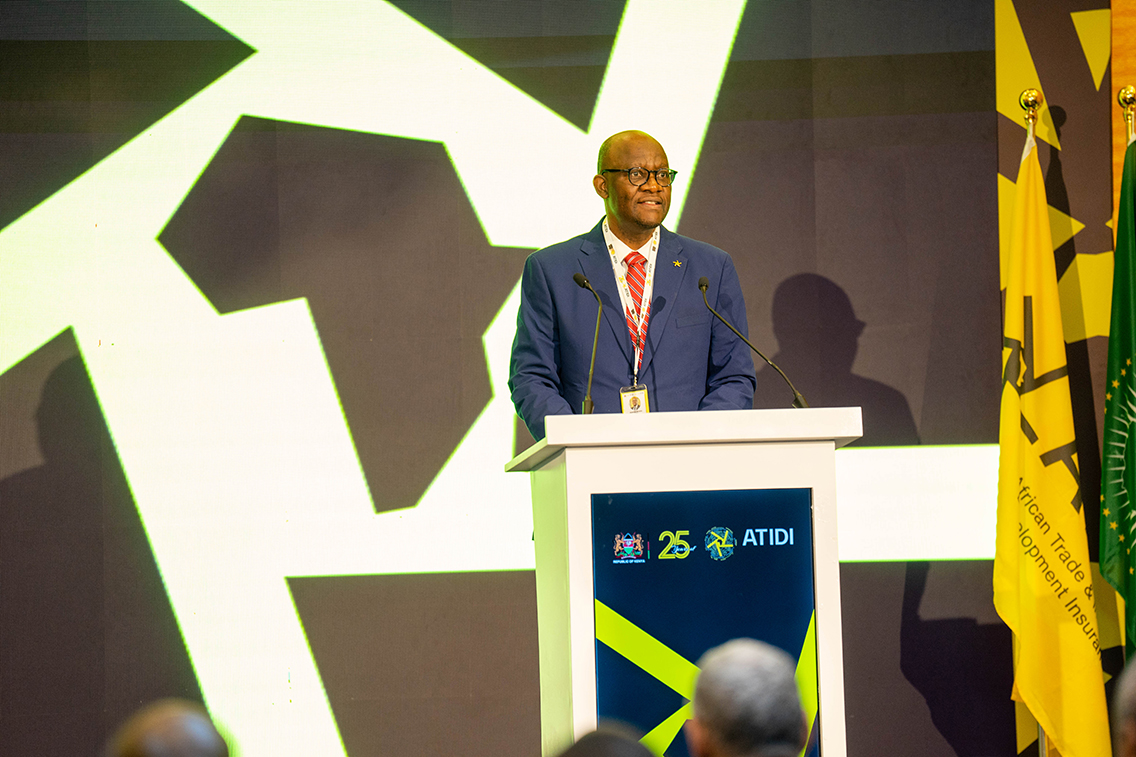
Hosted in partnership with the Government of Kenya, the meetings also marked ATIDI’s silver jubilee celebrations and drew the attendance of senior policymakers, development partners, investors and private sector leaders from Africa and beyond.
Rethinking Africa’s financial architecture
President William Ruto said that the reform of the global financial system which African leaders have long advocated for must be accompanied by a bold reimagining of the continent’s own financial institutions.
“For years, we have called for a fairer global financial architecture, one that stops mispricing African risk and making our capital needlessly expensive. That call remains right.. But Africa cannot wait for reform elsewhere,” he said at a state house gala dinner held to commemorate ATIDI’s 25th anniversary.
“We must complement the reform of the global financial architecture by building a stronger African financial architecture, one that mobilises African capital, mitigates African risk and finances African development on African terms.”
Africa holds nearly $4 trillion in long-term domestic savings through pension funds, insurance assets, and central bank reserves. However, much of this is invested overseas in part due to perceptions of elevated risk in domestic markets. This is despite Africa facing an annual financing gap of more than $400bn.
The continent does not suffer from a shortage of capital, Ruto argued. Rather it suffers “from a shortage of institutions capable of transforming risk, mobilising savings and connecting them to productive investment.”
He endorsed the establishment of the New African Financial Architecture for Development (NAFAD), an initiative launched by the African Development Bank Group (AfDB) to close the continent’s $400bn financing gap.
The initiative seeks to plug this funding deficit by leveraging the collective strengths of Africa’s largest multilateral financial institutions to share risk more innovatively, lower Africa’s financing costs, and fund transformative projects at scale.
At the heart of NAFAD is the Alliance of African Multilateral Financial Institutions (AAMFI), which brings together institutions like the AfDB, Afreximbank, Africa Finance Corporation, ATIDI, and others.
ATIDI’s recapitalisation is key
Ruto singled out ATIDI’s strategic role within AAMFI, highlighting the developmental impact that its guarantees have had in terms of unlocking private investment and correcting mispriced African risk.
“Within this Alliance, ATIDI occupies a uniquely strategic place. Investment follows confidence, and confidence follows credible risk mitigation,” he said.
ATIDI’s total assets grew by 20% year-over-year to $1.06bn in December 2025, while its total equity grew by 12% to $883 million over the same period. Ruto lauded this growth but called for ATIDI’s progressive recapitalisation to $2bn, noting that every dollar invested in the continent’s guarantee architecture has the potential to mobilise ten dollars more in private capital.
Indeed, through innovative insurance solutions that help derisk trade and investment, ATIDI has catalysed more than $93bn in private investment across Africa since inception in 2001 – despite its balance sheet having only crossed the $1bn mark last year.
Ruto launched the Nairobi Capital Compact on African Economic Sovereignty, which rests on five commitments: To progressively recapitalise ATIDI, to strengthen the Alliance of African Multilateral Financial Institutions, to mobilise Africa’s domestic capital, to expand the continent’s guarantee and risk-sharing capacity, and to build globally competitive African multilateral financial institutions
Framing the Compact as a blueprint for continental self‑reliance, Ruto urged other African countries to join Kenya in supporting the initiative. He announced that, subject to the necessary national processes, Kenya would increase its shareholding in ATIDI from $25 million to $65 million. He also presented ATIDI with the title deed for a two-acre parcel of land in the prime Upper Hill area of Nairobi for the construction of its permanent headquarters.
“It is time to back our own institutions, strengthen them, and give them the financial muscle to mobilise capital, mitigate risk, and drive the continent’s development on African terms,” he said.
“The goal is to move Africa from a recipient of global capital to a mobiliser of its own; and from dependence on external risk assessments to African institutions capable of pricing African opportunities accurately,” he added.
Strengthening investor confidence
At the AGM’s opening ceremony, Kelly Mua Kingsly, Chairman of the Board of Directors at ATIDI, argued that Africa’s economic advancement hinges on boosting investor confidence.
The continent’s vast natural resources or attractive demographics may capture investors’ interest, he argued, but projects will not be financed unless investors have the confidence to commit funds.
“Africa’s greatest asset is confidence. If capital is the engine of development, confidence is its fuel. That is where ATIDI has found its unique purpose. We do not merely mitigate risk. We create confidence,” he said.
Commenting on ATIDI’s silver jubilee – particularly its growth from seven founding members to 24 African member states, 13 institutional members and 1 non-African member state, all while maintaining investment grade credit ratings – Kingsly observed that ATIDI’s growth proves that “institutions built for Africa and by Africans can meet the highest international standards.”
Manuel Moses, ATIDI’s CEO, expressed confidence in the institution’s financial strength, underwriting capacity, and strategic direction, citing its strong results last year. In 2025, ATIDI recorded strong financial performance, with total exposure increasing to $9.2bn from $8.9bn in 2024 and profit for the year rising by 20% to $71.4 million.
“Against a backdrop of continued global uncertainty and the lingering effects of the COVID pandemic, ATIDI delivered another year of resilient growth in 2025, with strong results across insurance revenue, investment income and total equity,” he said.
Moses said that, since its founding, ATIDI has been “a trusted partner and a source of stability through periods of both growth and uncertainty.” He credited this to the ability to combine world-class standards with a deep understanding of African markets and the fact that ATIDI enjoys preferred creditor status.
ATIDI’s preferred creditor status ensures that member states prioritise obligations to it even during financial distress. This is what underpins investor confidence in ATIDI’s guarantees and is “fundamental to the business model”, Moses explained, urging member states to continue honouring this requirement.
ATIDI’s ability to drive development impact at scale while remaining commercially competitive has been instrumental in drawing increased support from existing and new shareholders. The AfDB in May announced that it approved the injection of a $125 million equity investment in ATIDI. This move raises its stake from about 3% to nearly 14% and makes it the largest shareholder in the guarantee platform.
Meanwhile, Germany’s state-owned development bank, KfW Development Bank, earlier this year made a $32 million equity investment in ATIDI, becoming its 13th institutional shareholder.
Leaders reflect on ATIDI’s legacy
Reflecting on ATIDI’s legacy, Kenya’s deputy president Prof. Kithure Kindiki, hailed ATIDI as a “remarkable African success story” and a critical player in Africa’s financial ecosystem.
“ATIDI has evolved into one of the continent’s most credible multilateral finance institutions, providing innovative risk mitigation solutions that strengthen investor confidence, catalyse trade, and drive sustainable development,” he said.
“ATIDI continues to demonstrate that de-risking investment is one of the most effective ways of attracting long term investment to African economies,” he added, citing its impact on Kenya’s economy.
Kenya remains a strategic market for ATIDI, with the organisation’s solutions unlocking more than $7 billion in investments across energy, transport, manufacturing, agriculture, and trade sectors.
Erastus Mwencha, former African Union deputy chair and a past COMESA secretary general, recounted the early days of ATIDI and how the organisation defied skeptics. Mwencha served as interim CEO of the organisation while leading COMESA and, together with development partners including World Bank , “laid a firm foundation to transform ATIDI from a regional initiative into a globally respected credit and political risk insurer”
“ATIDI was born out of a bold aspiration within COMESA to support a continent then unfairly dubbed as ‘hopeless’ which attracted just $17bn in FDI (foreign direct investment)… in 25 years we have proven the skeptics wrong, having unlocked $93bn in trade and investment across the continent,” Mwencha said.
The final day of the AGM was dedicated to investment promotion and business development and featured in-depth presentations on macroeconomic developments and proposed projects in Cameroon and Kenya. Projects in strategic sectors such as renewable energy, water, agriculture and transport were showcased.
The AGM programme also included a series of curated Business-to-Business (B2B) and Business-to-Government (B2G) meetings designed to connect investors, businesses and public sector stakeholders.