
European powers squabbled over the Gold Coast until, in 1664, the British achieved dominance, securing Cape Coast Castle and establishing a regional capital. Despite Britain’s control of the coast, much of the hinterland remained outside its influence for two centuries. As a major power in the Gold Coast, the “threat” of the Asante in the interior sparked an eventual clamour in Britain for decisive action, and in 1873 Sir Garnet Wolsey was ordered to sail from Liverpool to deal with the menace. A month later three battalions sailed from England and Ireland to join them.
Wolsey proceeded north from Cape Coast, marching some 10km a day during the relative cool of the morning, and resting his men during the heat of the day. The Asante kept tabs on the British troops but declined military engagement.
Wolsey’s first battle took place at Amoafo, about 110 miles north of Cape Coast. (Other sources give the nameas “Amoaful”.) Amoafo was the first demonstration of the superiority of British arms over the Asante weapons. Wolsey’s army of 2,200 men were heavily outnumbered by the Asante, possibly by a factor of ten to one, but the Asante’s outdated muskets were no match for the British breech-loading Snider-Enfield rifles, and assorted artillery and rockets. It was a massacre, leaving thousands of Asante dead – with the British suffering only four fatalities.
The victory at Amoafo no doubt galvanised the British troops’ morale as they pressed on the last 60km to Kumasi, but they were in for a surprise when they reached that city in early 1874.
As journalist-turned-historian Barnaby Phillips writes: “The streets were full of Asante soldiers, many of whom had fought at Odaso [a village 10km from Kumasi where the Asante mounted a final but futile defence of the city]. Hostilities appeared to be over; the Asante soldiers were armed but made no attempt to resist the invaders and some even greeted them with the words ‘Thank you’ repeated again and again.”
“To the victor the spoils” was the prevailing attitude of the invaders as they plundered the Asante’s palace and set fire to the city. This was not the only episode of British looting. After the Asante refused a British ultimatum to accept the imposition of protectorate status, Colonel Sir Francis Scott led a 1895-6 expedition to Kumasi where, once again, looting and arson took place.
Some of the artefacts stolen were shipped back to Britain while others were auctioned in Kumasi and distributed to British regiments as “souvenirs”. The defeated 13th Asantehene (Asante king) Agyeman Prempeh and a large royal retinue were marched by the British to Elmina, then sent to Sierra Leone before being exiled to the Indian Ocean islands of the Seychelles.
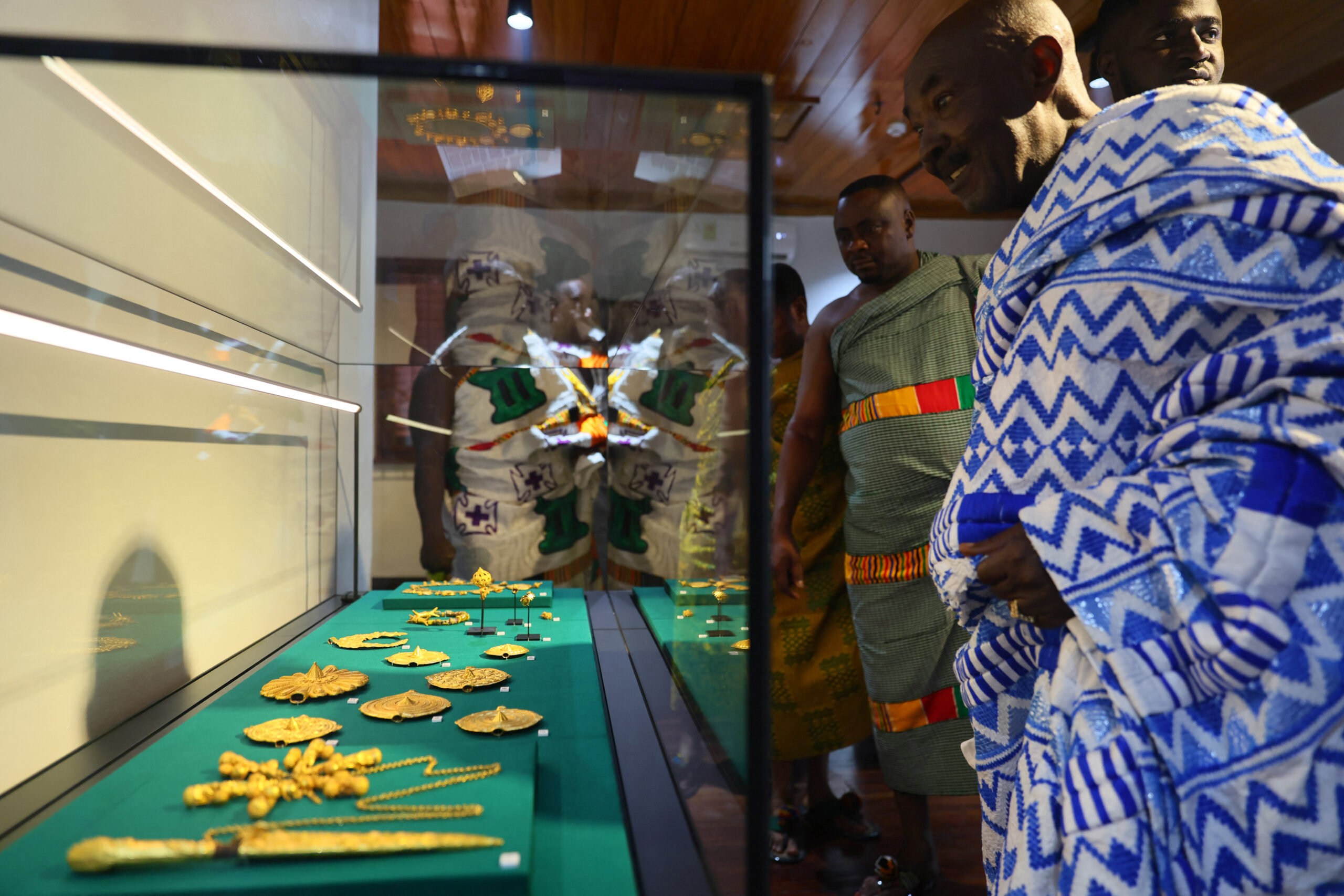
As for the plunder from Kumasi, little was reconciled or indeed restored by the British, until, in early 2024, Britain’s Victoria & Albert Museum loaned 17 pieces (pictured) and the British Museum 15 pieces of Asante treasure. It was only loaned, since British law does not permit giving back contested items in national collections, and long-term loan deals such as these are seen as a way to allow objects to return to their countries of origin.
This enthralling book outlines the long, complex and still contested history of the looted objects as it traces the extraordinary consequences of British imperial larceny.
The African Kingdom of Gold: Britain and the Asante Treasure
By Barnaby Phillips
£28 Oneworld Books
ISBN 9781836431336