

The emergence of artificial intelligence (AI) has reignited longstanding debates over sovereignty and dependency across Africa, now rearticulated through the language of digital sovereignty. Optimism about AI’s capacity to improve public services, strengthen logistics systems, and expand access to education is tempered by growing anxieties over job displacement, uneven value capture, and continued technological dependency on the US and China.
These competing and often antithetical perspectives raise fundamental questions: what does digital sovereignty actually mean in practice? And can African countries build competitive AI ecosystems without reproducing older forms of dependency through new technological infrastructures?
This analysis engages these questions by foregrounding the less examined relationship between dependency and African agency within the digital age. In particular, it scrutinises emerging calls for digital sovereignty as both a political aspiration and a strategic framework through which African states, firms, and institutions seek to reclaim technological futures, expand strategic leverage, and cultivate locally grounded technological capacity.
Simply put, digital sovereignty refers to a set of policy agendas that emphasise local data governance, domestically controlled compute capacity, the cultivation of a skilled digital workforce, and the adoption of legislation conducive to digital development. These ambitions unfold in a context where much of the digital infrastructure that underpins them remains externally financed, owned, or governed by multinational corporations headquartered in the United States, China, and Europe.
Within this uneven global system, the immediate goal of African governments should not be absolute digital independence, but the cultivation of strategic agency within deeply asymmetrical digital infrastructures. Because much of the infrastructure underpinning contemporary digital economies remains concentrated in a handful of powerful states and firms, complete autonomy is unrealistic in the near term. Under these conditions, digital sovereignty is better understood as an effort to expand African bargaining power within global digital systems. African governments must therefore consider how agency can be converted into leverage in negotiations over infrastructure, standards, and data governance. For the private sector, digital sovereignty also raises a fundamental question: who owns what African businesses are building on, and what does that ownership mean for the sustainability of firms, markets, and future scale?
Neither Here nor There: The Limits of Data Localisation
The debate over data localisation sharply illustrates these underlying tensions. Across Africa, digital sovereignty is increasingly framed as a question of storing data within national jurisdictions, with localisation presented as a pathway toward greater sovereignty and reduced dependency. Motivated in part by the popular metaphor of data as “the new oil,” this view treats data as a naturally occurring resource whose value lies primarily in its possession. Yet the metaphor confuses more than it reveals. Unlike oil, data is neither naturally scarce nor intrinsically valuable. Its value is produced through the infrastructures that render it useful and actionable: cloud systems, standards regimes, computational capacity, and the human labour required to organise, process, and interpret it. Simply storing data locally does not automatically translate into digital sovereignty if the infrastructures used to process, analyse, and monetise that data remain externally controlled.
Wittingly or unwittingly, the oil analogy authorises a kind of sovereignty shortcut, reinscribing an anachronistic conception of sovereignty in which data storage and location become conflated with meaningful control over the infrastructures through which economic value is generated. More interestingly, this framing of digital sovereignty has created new commercial and geopolitical opportunities for firms such as Huawei to expand their data center and cloud infrastructure services across Africa under the promise of delivering sovereign digital capacity. While data localisation policies have expanded, the continent’s cloud ecosystem remains highly concentrated among a small number of foreign providers, including Amazon Web Services, Microsoft Azure, Google Cloud, and Huawei Cloud. Accordingly, in practice, territorial location does not automatically confer infrastructural authority or meaningful value creation.
To be sure, sector-specific localisation —particularly for sensitive government, security, health, or electoral data—may operate as a legitimate public-interest safeguard. In certain contexts, localisation can also stimulate domestic investment in data centres and digital infrastructure. However, its broader developmental consequences remain far more ambivalent than popular rhetoric often suggests. Expansive localisation efforts may inadvertently restrict access to interoperable datasets, transnational innovation ecosystems, and collaborative computational environments necessary for technological scaling and integration.
The chart (figure 1) makes clear that digital sovereignty cannot be reduced to the physical location of data, though local infrastructure remains indispensable. Africa’s limited share of global data centre capacity reveals a deeper structural constraint: the continent exercises limited control over the infrastructures through which data is transformed into economic, political, and strategic value. Expanding African data centre capacity is therefore necessary, but insufficient. If these facilities are primarily financed, owned, operated, or governed by external firms, localisation may ultimately reproduce dependency under the language of sovereignty itself.
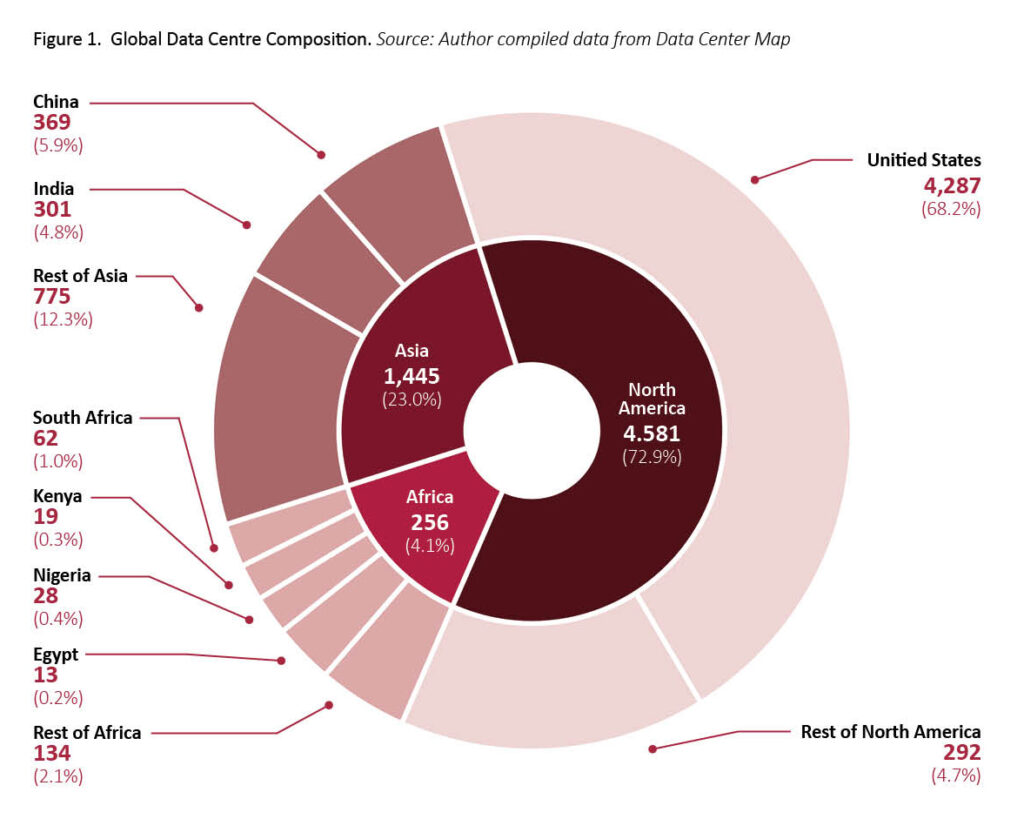
Meaningful digital sovereignty depends not just on hosting data locally, but on ensuring African institutions can shape AI supply chains and the higher-value layers of the digital economy. This includes influence over how data is collected, processed, stored, and governed, as well as over digital infrastructure ownership, standards, and technical capacity. Without deeper participation in these domains, digital sovereignty risks being an empty promise.
The hidden labour of AI
The challenges of unequal, globally interconnected digital systems—and Africa’s position within them—are perhaps most visible in contemporary African data work. While the United States and China continue to dominate frontier AI models, semiconductor production, and cloud infrastructure, much of Africa’s participation remains concentrated in the “ghost labour” that sustains these systems beneath the headlines and billion-dollar valuations. Investigations revealed that Kenyan workers were paid less than $2 per hour to label toxic content used to train major generative AI systems. In many respects, the continent currently occupies the position of AI’s “janitorial staff,” performing the labour-intensive work of cleaning, labeling, and moderating data for systems whose ownership, computational capacity, and economic rewards remain concentrated upstream.
This position within the AI economy reflects a deep structural imbalance: although African labour contributes directly to the maintenance of AI systems, control over frontier models, hyperscale infrastructure, and computational resources remains externally concentrated. The danger, therefore, is not exclusion or absence from the AI economy, as is often implied by anxieties about being “left behind” in the Fourth Industrial Revolution, but subordinate incorporation into it: a position in which Africa supplies labour, data, and consumers while higher-value layers of technological accumulation, platform ownership, and infrastructural control remain externally concentrated. The issue is therefore not simple exclusion, but the terms of incorporation.
African agency under conditions of dependency
Nonetheless, reducing Africa’s role to subordinate integration and dependency alone would lose sight of the forms of agency emerging within these uneven and interconnected digital systems. For many AI startups across the continent, the primary site of agency does not lie at the foundational layers of the digital stack, where frontier models, semiconductor production, and computational infrastructure remain dominated by US and Chinese firms. Rather, agency increasingly emerges at the application layer, where globally produced technologies can be localised, adapted, and operationalised for specific social and market contexts.
African entrepreneurs are leveraging tools such as ChatGPT and DeepSeek as infrastructural building blocks through which tailored services can be developed at comparatively low cost. Start-ups developing AI-powered legal, financial, healthcare, and educational tools are creating locally relevant applications capable of responding to linguistic, regulatory, and social conditions often overlooked by global technology firms. What is significant here is not merely innovation itself, but the conditions under which it occurs. These firms do not operate outside global technological dependency; they build localised services atop infrastructures, models, and cloud systems they neither fully own nor govern.
African agency in the digital economy is, therefore, neither binary nor synonymous with complete technological autonomy. Rather, it is contingent and unevenly distributed across the digital stack, where African firms exercise meaningful forms of adaptation and localisation even as deeper layers of computation, cloud infrastructure, and platform ownership remain externally concentrated.
These uneven forms of agency place African telecommunications firms and governments in a strategically important position within the continent’s AI transition. Telecom companies increasingly control the networks through which data, digital services, and AI applications circulate, giving them opportunities to move beyond connectivity provision toward greater investment in regional cloud infrastructure, computational capacity, and African-owned digital platforms. Similarly, African governments cannot approach AI merely as a startup or innovation issue. AI governance must be integrated into broader industrial, educational, energy, and infrastructural strategies capable of strengthening long-term technological capacity.
At the same time, meaningful digital sovereignty cannot be delimited to state control or technological isolation. The challenge is not to eliminate interdependence altogether, but to negotiate it from a position of greater institutional and infrastructural strength. This is especially important given Africa’s internal constraints, including weak electricity systems, fragmented regulatory environments, and underinvestment in technical education and research. Ultimately, Africa’s position within the global AI economy will depend less on achieving complete technological autonomy than on building the human capital, digital infrastructure, and regional coordination needed to exercise greater leverage within uneven and interconnected global digital systems.
What does strategic leverage and agency exactly look like within the pursuit of African digital sovereignty? The next paper offers a more detailed account of how African governments and businesses can manage dependency, negotiate more favorable terms, and use their positionality within global digital systems to advance digital-driven growth.