
The Democratic Republic of the Congo (DRC) has an estimated $24 trillion in untapped mineral wealth, 80m hectares of arable land and 13% of the world’s total hydropower potential. That should add up to vast economic potential. Yet, despite this, weak national infrastructure has long proved to be a major obstacle to attracting foreign direct investment (FDI) and achieving sustained economic growth. Indeed, the DRC “faces possibly the most daunting infrastructure challenge on the African continent,” the African Development Bank (AfDB) has argued.
“Conflict has seriously damaged most infrastructure networks,” the AfDB points out, with the country’s “vast geography, low population density, extensive forestlands and crisscrossing rivers complicating the development of new networks”.
The DRC’s road infrastructure is particularly limited. As the Atlantic Council think tank has noted, the country has only 152,400 km of roads to serve a territory of 2.45m square km, giving a “road-to-territory ratio that is just 40% of the Sub-Saharan African average of 0.14km/km, which is already low compared to other regions”.
Fewer than 10% of these roads are passable all year, with more than 50% of Congolese having to travel an hour or more to reach a paved road. For business and exports, poor road conditions and limited networks often cause transportation delays and challenges, with transport costs in the DRC accounting for 40% to 60% of the final prices of some goods.
Roads are not the only component of the DRC’s infrastructure that is currently lacking. Less than 20% of the country’s population has access to electricity, with the number dropping to just 2% in rural areas.
Such infrastructure gaps inevitably constrain the DRC’s ability to stimulate private sector activity. Consultancy S&P Global notes that “the growth rate of the non-extractive sector is limited due to a critical infrastructure gap and low degree of financing inclusion.
“In 2025, the extractive sector grew by 10.1% while the rest of the economy grew by only 3.1%, despite very rapid population growth which would normally steer consumption up and drive public and private investments,” Data provider S&P argues. “In our view, this somewhat low growth is related to a critical investment gap and the absence of well-functioning credit markets, which limits development and investment potential.”
The AfDB similarly says that “the country’s huge infrastructure deficit continues to impede private investment and limit sector contribution to economic growth,” while Calixte Ahokpossi, the International Monetary Fund’s mission chief to the DRC, notes that “weak infrastructure inflates costs, constrains businesses and fosters economic disparities.”
Infrastructure commitments
There have been some moves on the part of international organisations to help plug the DRC’s infrastructure gap. Between 2021 and 2024, for example, the International Finance Corporation (IFC) committed a total of $550m to energy and infrastructure projects in the DRC.
In July 2025 the World Bank also agreed to $1.9bn worth of project loans to develop infrastructure, including $250m for the Grand Inga dam. If realised, the dam would generate 44 GW of power and be the largest power-producing facility globally.
The DRC is, however, increasingly looking to tap private capital for infrastructure investment. In April this year the DRC issued its first Eurobond, with the $1.25bn raised earmarked for infrastructure investment. The transaction was structured in two parts, with a five-year tranche at 8.75% and a ten-year tranche at 9.5%.
The DRC’s finance minister, Doudou Fwamba Likunde, has said that the proceeds from the Eurobond will be channelled primarily into hydropower and transport infrastructure. While specific plans are yet to be confirmed, the DRC’s government has previously outlined its National Strategic Development Plan (NSDP), which includes seven key initiatives to boost growth and economic development.
In terms of infrastructure, the NSDP prioritises the building of a new airport terminal in Kinshasa and modernising the RN4 road between Kisangani and Beni to boost rural connectivity. There are plans to improve 300 km of roads in the capital, as well as to build a ring road around Kinshasa to decongest the city.
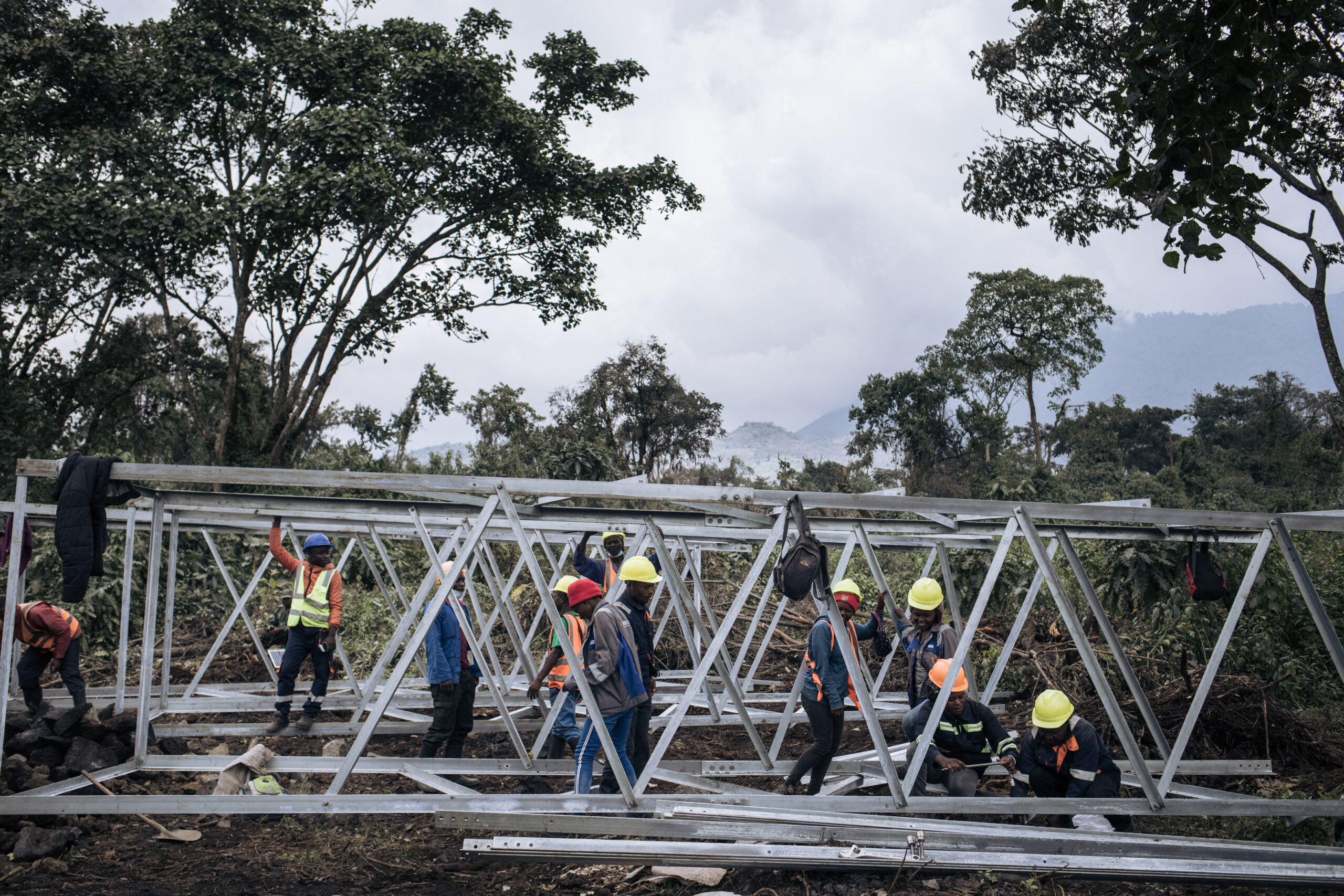
The government also has plans for a 330 kV electricity transmission network to connect neighbouring Zambia with the DRC’s copperbelt, and to construct 64 MW of hydro projects in the Kasaï-Central district to strengthen energy supply in the region.
Investing in infrastructure projects such as these has long been considered essential to making it easier to do business in the DRC and generate stronger growth. Although DRC-specific numbers have not been calculated, the OECD argued in 2025 that investing $115bn per year in African infrastructure development could more than double Africa’s GDP by 2040 and boost the continent’s annual GDP growth by 4.5%.
Getting lenders onboard
To support that level of infrastructure investment, however, it is likely that the DRC will need to retain the confidence of international capital markets. According to the DRC’s finance ministry, orders for the recent Eurobond exceeded $5.2bn, meaning it was oversubscribed by more than four times.
Mark Bohlund, senior credit research analyst at REDD Intelligence in London, tells African Business that the DRC’s relatively strong macroeconomic position, combined with its increasingly close relationship with the United States, helped make the bond attractive to international investors. “The DRC’s low level of external debt, combined with strong foreign exchange earnings from mineral exports, appear to have been the strongest draw for investors in the DRC Eurobonds,” he says. “I personally suspect that the increased US involvement in the DRC in general, and the mining sector in particular, was also a contributing factor.”
Leo Morawiecki, emerging market debt investment specialist at Aberdeen Investments, similarly notes that the DRC’s strong macro position made the Eurobond particularly appealing for investors – and potentially puts Kinshasa in a strong position to raise further funds for infrastructure investment.
According to the AfDB, the DRC has a debt-to-GDP ratio of 16.1% – well below the sub-Saharan Africa average of around 60% – which gives it considerable headroom to borrow for infrastructure investment.
“The DRC has a relatively low fiscal deficit, quite a well-balanced current account, a very low debt-to-GDP ratio, and the arrears are pretty small,” Morawiecki tells African Business. “They are also in an IMF programme, and it is always very comforting to investors when you have that kind of policy anchor.”
Political risks
Bohlund notes that there are potential risks that could impact the DRC’s ability to gain further access to capital markets in the future. “The biggest risk is connected to political transition,” he says. “The fate of former President Joseph Kabila, currently sentenced to death in absentia and under US sanctions, indicates that it is far from certain that whoever succeeds [current President Félix] Tshisekedi will honour the obligations of his or her predecessor, especially if there is little to show for the use of the proceeds.”
Morawiecki says that “the biggest political elephant in the room is the conflict [with the M23 militia] in the east of the country, but the region impacted was only contributing around 5% of total central government revenues prior to the M23 takeover, so the fiscal impact is relatively small.”
While some political and security risks remain, the DRC’s recent Eurobond issuance suggests that international investors are increasingly willing to back the country’s long-term potential – and help fund its ambitious infrastructure plans.
Should the government deploy this capital effectively and maintain investor confidence, the DRC could leverage international financing to plug vital infrastructure gaps and unlock its long-term economic potential.