
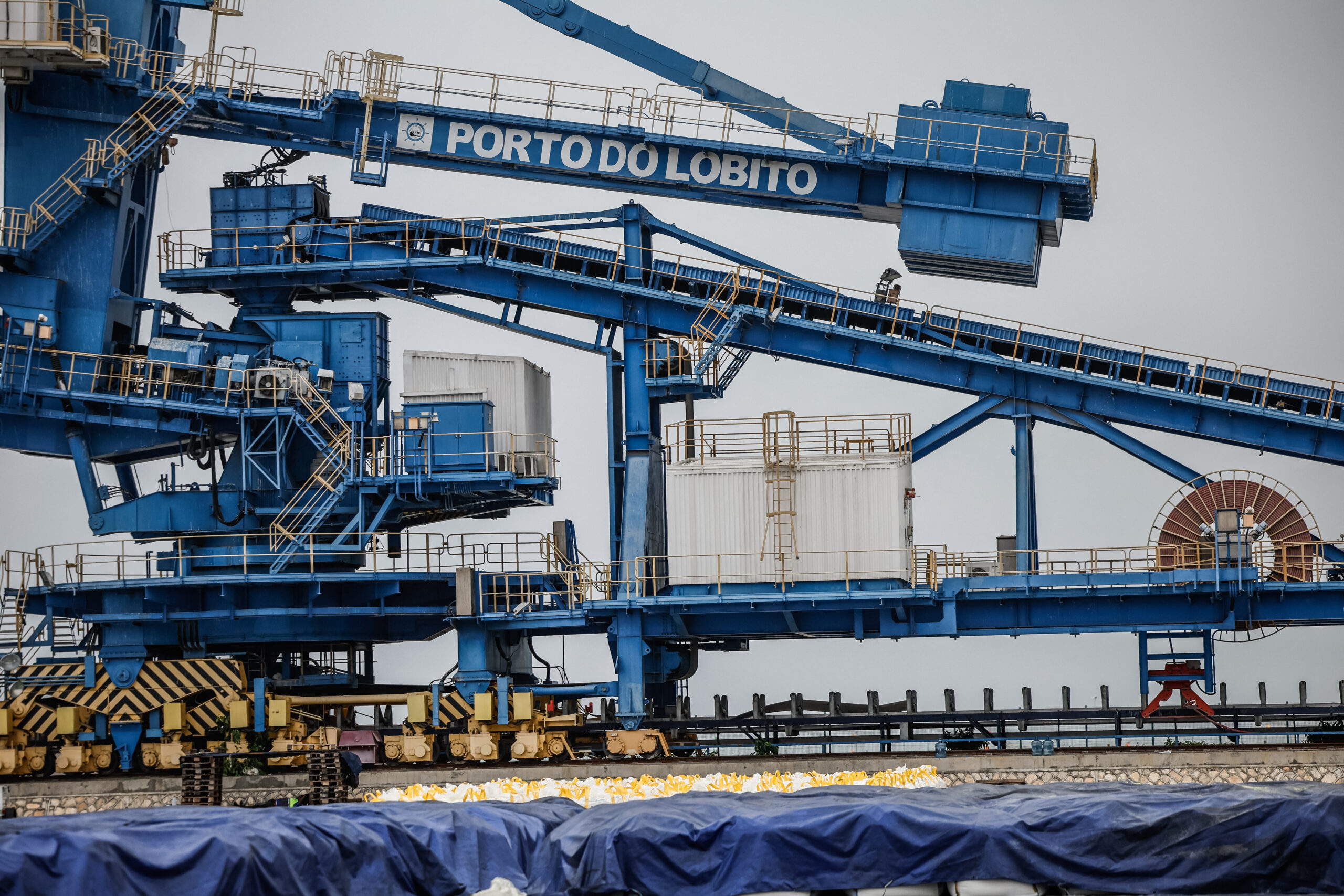
In December last year the United States and the European Commission released a statement affirming their “shared commitment to promoting peace, security and economic growth in the Great Lakes region of Africa”. It expanded: “together, we are focused on creating the conditions necessary for increased US and EU investment across the region, recognising that economic development is a cornerstone of long-term stability. Central to this effort is the Lobito Corridor, a transformative infrastructure project that will enhance regional connectivity, secure critical mineral supply chains and drive sustainable economic growth.”
The core of the Lobito Corridor is a 1300 km railway stretching from Angola’s port of Lobito to the copperbelt regions of the Democratic Republic of Congo (DRC) and Zambia. It is so far only partly operational , with minerals already travelling from the DRC to Angola. The extension to Zambia is planned to be completed by 2029.
The central aim behind the Lobito Corridor is to make it much easier and quicker for critical minerals in central Africa to reach global markets. The DRC alone is believed to be home to up to 70% of the world’s cobalt reserves, with the continent more broadly possessing about 30% of global critical minerals reserves.
The journey from the DRC’s copperbelt to an African export port – such as South Africa’s Durban or Tanzania’s Dar-es-Salaam – has traditionally taken three weeks or more, via a combination of road and rail.
Congestion or other logistical challenges have often pushed transit times up to as long as 45 days. By contrast, recent shipments from the DRC’s mining city of Kolwezi to Lobito have taken as little as six days.
Geopolitical railway
The United States is heavily financing the Lobito Corridor project, which it sees as central to its attempts to reduce the influence of China in Africa’s critical minerals industry, which is increasingly vital to the global economy.
Especially given how essential critical minerals are for the production of technologies such as electric vehicles, batteries and semiconductors, the US sees reducing China’s sway over this industry as crucial for maintaining a competitive advantage in the industries of the future.
In December 2025 the US International Development Finance Corporation (DFC) announced a $550m financing project to support upgrades to rail infrastructure in Angola. The State Department has previously claimed that the US has mobilised close to $6bn in financing for the Lobito Corridor.
Christopher Vandome, senior research fellow at the Chatham House think-tank in London, tells African Business that the Lobito Corridor forms a central part of the US strategy to compete with China in this vital industry.
“American critical minerals interest is driven by trying to compete with China and de-risk supply chain vulnerabilities,” he says. “The US has one of the largest number of mines in the world, alongside China, but they do not mine everything they need. They are very vulnerable to market volatility, both in terms of the pricing of metals as well as supply vulnerabilities for industry, so that is driving their outward expansion.”
What’s in it for the DRC?
The DRC government has framed the Lobito Corridor as a flagship project central to its wider aims for economic development. In April 2026 Prime Minister Judith Suminwa Tuluka said that “the development of the Lobito Corridor must first and foremost benefit our people. It must improve living conditions, support health, create jobs and strengthen the dignity of communities… The Lobito Corridor must not be just an infrastructure project, but a real lever for economic transformation serving the people.”
The DRC’s President Félix Tshisekedi has estimated that the project will ultimately create approximately 30,000 direct and indirect jobs in the DRC.
The Angolan government’s website for the project, Corredo do Lobito, claims the project has to date created 7,500 direct and indirect jobs across the three countries.
One among many
Jean-Marie Kanda, senior advisor on critical minerals to the president of the DRC, tells African Business that the Lobito Corridor is playing a vital role in plugging the DRC’s infrastructure gap – but that it is only one part of the strategy to enhance regional connectivity and generate further growth opportunities: “the DRC is involved in the development of the Lobito Corridor because it is one of the infrastructure projects that can help mining companies significantly reduce the amount of time it takes for minerals to be transported from the mines to the ports for export.
“There is also a major road under construction that will connect Lualaba Province and Solwezi, Zambia’s minerals hub,” Kanda says.
“This will also reduce the time it takes for exports to reach ports in Tanzania. The road is about 80% complete – they just need to finalise a few administrative tasks, such as sorting out customs at the DRC-Zambia border.”
“Internally, we are also building a corridor from Sakania to Banana,” he notes. “This backbone is just as important as the Lobito Corridor.” Due to be completed in 2027, this corridor will fully pave the DRC’s existing “National Road No.1” which links its eastern border to the Atlantic coast. The $1bn project is being financed under a Sino-Congolese cooperation programme and is being delivered in partnership with Chinese contractors.
“These infrastructure projects are themselves an opportunity for investment and we are also seeing American and Canadian companies being interested to come and invest,” Kanda adds.
One of the aims behind the Lobito Corridor is to “de-risk” the mining sector for the private sector and thereby facilitate greater foreign direct investment (FDI) flows. Conor Savoy, visiting fellow at the Center for Global Development in Washington DC, notes that “Western mining firms largely left the DRC because of infrastructure challenges and other issues that put pressure on their margins.”
Benefits beyond the mines?
But Savoy suggests that, for the full economic potential of the Lobito Corridor to be realised, there should also be a focus by the DRC and its international partners on “soft” as well as “hard” infrastructure projects.
“I would argue that the US strategy in the DRC and Africa’s mining industry more widely is overweight on DFC-led financing projects and underweight on soft infrastructure initiatives,” he tells African Business.
“Western firms have encountered challenges navigating the DRC as a result of things such as corruption, workforce training issues… the prevalence of artisanal mining.
“The DFC is very useful in providing loans and financing for hard infrastructure but partnering with the DRC to work on resolving some of these issues was more of a matter for USAID, which of course has now been closed down,” Savoy adds.
The wider ambition is that the Corridor and associated infrastructure projects will have positive benefits for a broad range of industries, beyond just the export of critical minerals.
The EU has noted that “by reducing freight transit time from Zambia/DRC to the sea from over a month to just one week, the Lobito Corridor is transforming how goods move across central and southern Africa. It is opening markets for farmers, small businesses and industries while creating new jobs and lowering carbon emissions.”
Kanda similarly emphasises that the construction of the Lobito Corridor is designed to promote “the development of an ecosystem that promotes agriculture, agricultural businesses [and] other industries and services beyond just the logistics hub.”
Vandome notes that more action is required to translate the bold ambition behind the Lobito Corridor into reality. “There is still a huge amount of work to be done logistically, both on the physical railway itself and on the wider projects required to make this the grand economic corridor that often gets talked about,” he says.