
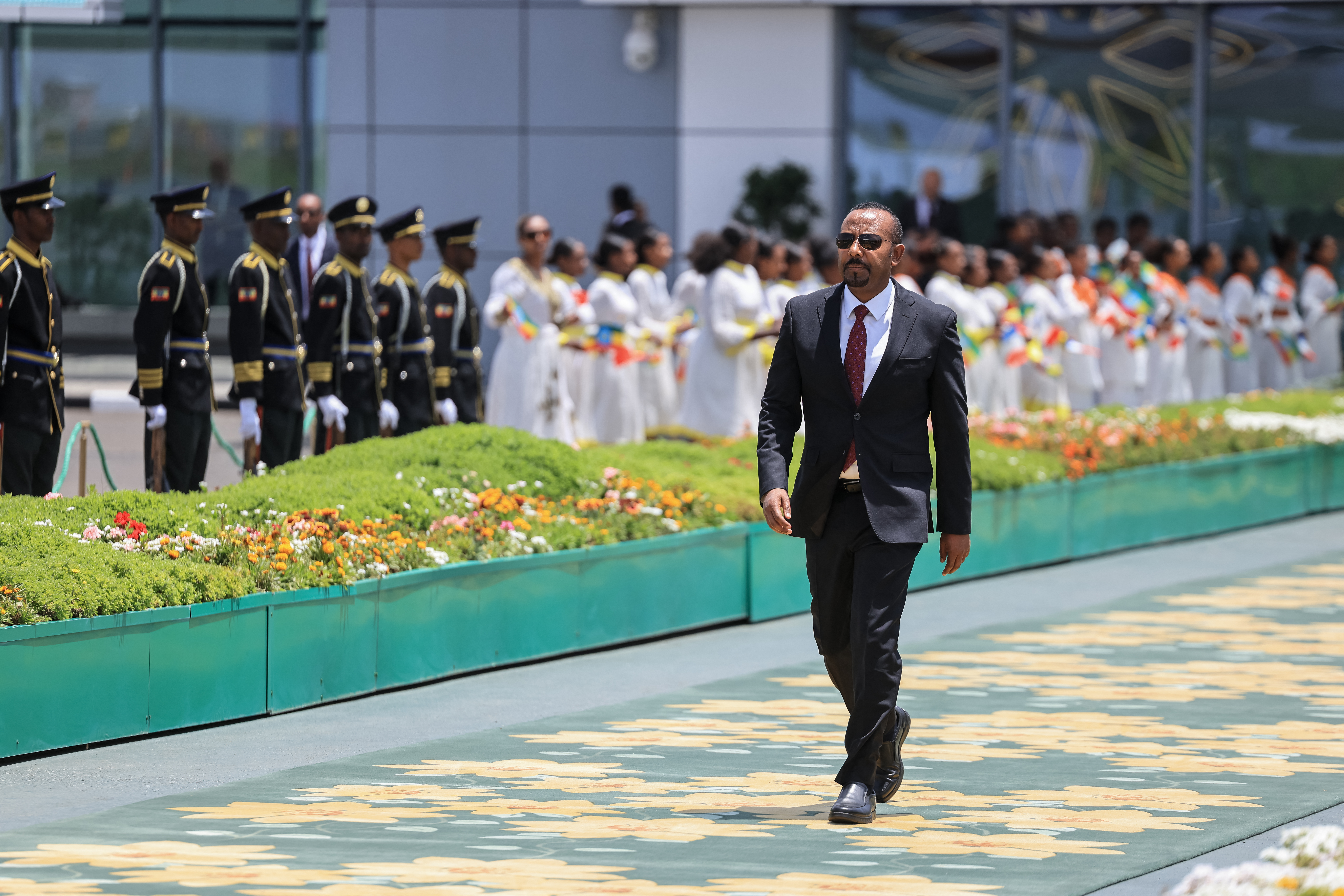
Ethiopia Prime Minister Abiy Ahmed has claimed a landslide victory in the East African country’s national elections this month, with his “Prosperity Party” winning 438 of the 501 contested seats.
More than 50m people registered to vote in Ethiopia, however no election was held in northern Tigray due to what election officials called “unfavourable conditions” in the aftermath of the civil war in the region and continuing instability. Voting was also disrupted in parts of the Oromia and Amhara regions as a result of security concerns.
Observers from regional organisations such as the African Union and the Intergovernmental Authority on Development were in Ethiopia to oversee the election and to guarantee its legitimacy. They were, however, largely confined to the capital, Addis Ababa, and have been criticised for not deploying more observers across the country.
Melatework Hailu, the chairperson of the National Election Board of Ethiopia (NEBE), has said that the board demonstrated “institutional neutrality and performed its duties solely in accordance with the law and electoral guidelines, without interference”.
However, most analysts suspected the result of the election was never truly in doubt, with opposition parties accusing Abiy of detaining rival leaders and restricting their political activities.
Nonetheless, the election could prove to be a significant moment for Ethiopia should Abiy claim a mandate for further radical changes as he prepares to be sworn in for another prime ministerial term in October.
Centralisation of powers expected
Analysts expect that Abiy will use his “supermajority” to push for deeper centralisation of government powers.
Ahmed Soliman, senior research fellow at the Chatham House thinktank in London, tells African Business that “there has been a lot of suggestion that Abiy will try to move towards a first-past-the-post presential system, which, in my view, would further weaken parliamentary accountability and oversight while strengthening the centre in terms of its governing mandate.
“There has also been an idea of breaking down strong regions like Amhara or Tigray – which have long been resistant to central government – into smaller and more controllable parts,” Soliman adds, although he is sceptical this would work.
The election comes at a time when Ethiopia is grappling with internal division. The Tigray region remains tense following the end of the civil war in November 2022. Soliman says there has also been a rise in “Amhara first” nationalism and resistance to the federal government in that region.
In Oromo, there are ongoing clashes between government forces and the Oromo Liberation Army (OLA), with other ethnic groups, such as Ethiopia’s Somali population, also feeling disillusioned with Addis Ababa.
Soliman is concerned that Abiy’s potential push for further powers in the aftermath of the election could further ignite these tensions.
“There has yet to be a national dialogue that has brought civic groups and citizens together for an honest discussion about the future nature of the federation,” he says. “What you have had instead is a visceral response by some groups, which has furthered ethnonationalism in the country and led to armed responses.”
Merara Gudina, a professor at Addis Ababa University and an opposition leader, has similarly warned that the result of the election could “negatively affect the already deteriorating stability of the country”.
Soliman adds that the ongoing tensions in Tigray have further fuelled instability across the country by weakening the government’s ability to respond to other threats. The Council on Foreign Relations, a New York-based thinktank, has noted that “tensions in Ethiopia’s Tigray region have escalated significantly, threatening to reignite conflict between Ethiopia and Eritrea and destabilise the Horn of Africa.”
Soliman says that “the majority of Ethiopia’s national armed forces have been moved to the north to prepare for a renewed conflict with Tigray, which exposes government forces in other parts of the country, such as Oromia and in the Somali region as well.”
“There is this growing sense of internal insecurities arising, with opposition groups coming together to form tactical alliances against Abiy and the federal government,” Soliman tells African Business. “It remains to be seen how serious a threat that will pose to the federal government in the post-election landscape.”
Abiy’s economic agenda
This complicated security environment could also have economic ramifications for Ethiopia. Abiy’s Prosperity Party campaigned on the back of its perceived economic successes, citing improved food security and strong growth rates. In February, Abiy forecast a 10.2% growth rate for this year as a result of IMF-backed economic reforms, the easing of foreign exchange restrictions and greater foreign direct investment flows.
However, Aaron Stanley, deputy director of the Africa Programme at the Center for Strategic and International Studies in Washington DC, has warned that internal conflict could cloud Abiy’s economic reform agenda.
“Military and police spending, conflict-induced displacement and the impact of internal insecurity on investor risk perception ultimately limit the extent to which macroeconomic reform can achieve its objectives.
“Similarly to how these elections were only held in certain areas of the country, if economic reform is selectively implemented, there is a risk that regional and urban-rural inequality could grow significantly, further exacerbating tensions between the federal government, regional entities and organisations representing different constituencies.”
Stanley expects a further update to Ethiopia’s Home Grown Economic Reform (HEGR) programme in a bid to accelerate reform in certain areas.
“The post-election moment provides a politically convenient window to release an updated version of HGER even if the general expectation is continuity of economic reforms. In a new iteration of HGER, one can expect accelerated execution where the government has already made commitments, little movement where reform would threaten political control, and a widening gap between the formal liberalisation narrative and the governance environment surrounding it.”
David Shinn, former US ambassador to Ethiopia, expects Abiy to continue making progress with his economic reform agenda.
“Abiy Ahmed has done a much better job of liberalising and strengthening the economy than he has of ending internal political insurgencies and security challenges,” Shinn tells African Business. “I expect this trend to continue over the foreseeable future: Ethiopia’s GDP will maintain impressive growth and the foreign currency exchange market will remain liberalised.”
Race to the sea
Shinn predicts, however, that Abiy’s desire for access to ports on the Red Sea – in particular his so far studiedly vague claim on Eritrea’s Assab port – will become a key priority in the aftermath of the election. In the run up to June’s election, Ahmed said he expected the next generation of Ethiopians to succeed in reaching the Red Sea if the current generation of leaders could not do so in a “reasonable” and “fair” way.
“One unachieved political and economic goal, access to the sea, will become front and centre on Abiy’s agenda,” Shinn tells African Business. “Hopefully, he will pursue this goal through diplomacy and not military force.”