
The US could add a 12.5 percentage point tariff on imports from seven African countries that the Trump administration says have failed to meet labour standards.
The proposed executive action would be taken under section 301 of the Trade Act of 1974, which authorises the President to take action against “foreign trade practices that are unreasonable or discriminatory and that burden or restrict US commerce”. It could apply to seven African countries – Algeria, Angola, Egypt, Libya, Morocco, Nigeria and South Africa – which the US says have failed to impose and effectively enforce a prohibition on forced labour.
In March the US Trade Representative (USTR) initiated investigations into the labour practices of 60 countries from which 99.4% of US imports are shipped. On 3 June the USTR released a report which claimed that 54 economies “have failed to impose a legal prohibition on the importation of goods produced wholly or in part with forced labor and to effectively enforce such a prohibition.” It said that a further six “have failed to effectively enforce a forced labor import prohibition.”
It concluded “that the acts, policies, and practices of each economy investigated are actionable under Section 301 of the Trade Act.”
Egypt, Morocco and South Africa most exposed
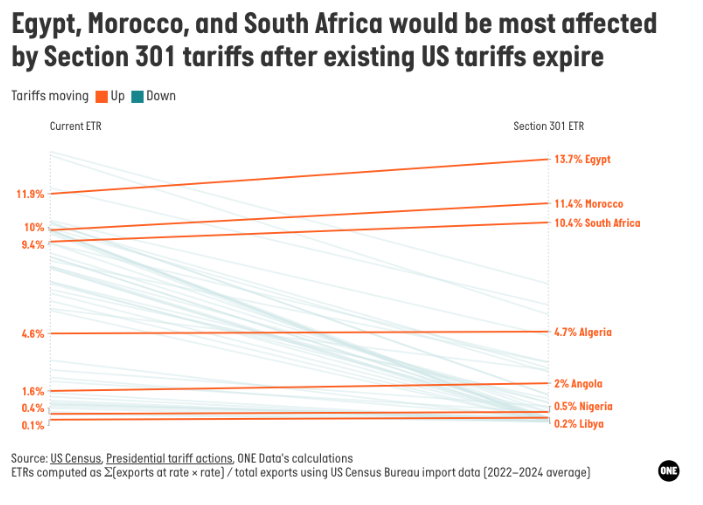
ONE Data has calculated the effective tariff rate (ETR) of the proposed tariffs on the seven targeted African countries. The ETR is a measure of a country’s average tariff burden, given that different products face different duties and countries’ exports differ. A country that exports mostly exempt or lightly tariffed products will have a low ETR, even if headline rates are high; one concentrated in heavily tariffed sectors will feel a much larger impact.
The new tariff would not apply to goods already covered by steel, aluminium and copper tariffs of up to 50%, nor auto tariffs, nor to roughly 725 listed products.
It found that Egypt, Morocco and South Africa are the African countries most exposed to the potential new tariff. Egypt ($2.6bn annual exports to the US) faces the sharpest ETR increase, rising 1.9 percentage points (pp) from 11.9% to 13.8%. Over half of its export value is textiles and apparel: knitted garments ($687m, +2.5pp) and woven garments ($502m, +2.5pp) together account for nearly half the total basket, with carpets ($124m, +2.5pp) adding further exposure. The consumer goods and textile & apparel sectors together drive virtually the entire ETR uplift.
The ETR on Morocco’s $1.8bn of exports would increase from 9.9% to 11.4%. Apparel – woven ($228m, +2.5pp) and knitted ($60m, +2.5pp) – provides the bulk of its ETR uplift, along with prepared fish ($92m, +2.5pp) and edible fruit ($197m, +2.0pp). The agricultural sector as a whole ($424m, +2.1pp) is the second-largest driver after textiles.
South Africa has the largest US export base of any African economy at $14.6bn and Section 301 would add 0.9pp to its current ETR to reach 10.4%. Precious metals, stones and jewellery ($8.3bn – 57% of the total) are the single largest contributor to the ETR change. Tariffs on vehicles ($2.1bn) are already subject to the 25% auto tariff, so section 301 would have no additional impact. Among the exposed product categories, organic chemicals ($270m, +2.4pp) and nickel ($143m, +2.5pp) are notable despite their smaller scale in terms of exports to the US.
By contrast, the four African countries less exposed to the new sanctions are all major exporters of crude oil, which already carries near-zero tariffs and would not be subject to the proposed section 301 surcharge. The ETR changes for Libya, Nigeria, Algeria and Angola are expected to be negligible.
US bid to revive faltering tariffs agenda
The threat is the US’s latest attempt to revive its stuttering tariff agenda, a centrepiece of Trump’s trade and economic policy which has faced major legal hurdles. Trump’s plan for wide-ranging tariffs on imports suffered a heavy blow when the Supreme Court ruled that the International Emergency Economic Powers Act (IEEPA), introduced in 1977, does not authorise the President to impose tariffs on imported goods.
Trump reacted by immediately using alternative statutory powers to impose a new 10% global tariff to replace those struck down by the Supreme Court. However, the new provision caps global tariffs at 15% and lasts only 150 days, meaning it will expire on July 24 unless extended by an Act of Congress. The US Court of International Trade has ruled that it too is unlawful, though an appeals court has allowed the tariffs to continue while that initial ruling is appealed.
According to the Brookings Institution, “The administration moved quickly to unprecedented use of Section 122 of the Trade Act of 1974 – a temporary authority intended for balance-of-payments emergencies – imposing a 10% global tariff while signalling its intention to rely more heavily on Section 301 investigations to establish a more durable legal basis for country-specific measures.
“Section 301 is slower and procedurally constrained but may support more permanent tariffs once investigations are complete.”
The US claims that a failure to tackle forced labour “burdens or restricts US commerce by subjecting US producers to unfair competition from forced labor goods in both export markets and the US market.”
Alongside the seven African countries, the list includes traditional US allies such as the UK, Australia, Saudi Arabia and South Korea.
A public comment period for Section 301 runs through 6 July 2026, after which the US government will make a final determination on whether to move forward with the new tariffs.
– Data compiled by Miguel Haro Ruiz
– This article was produced in partnership with ONE Data