
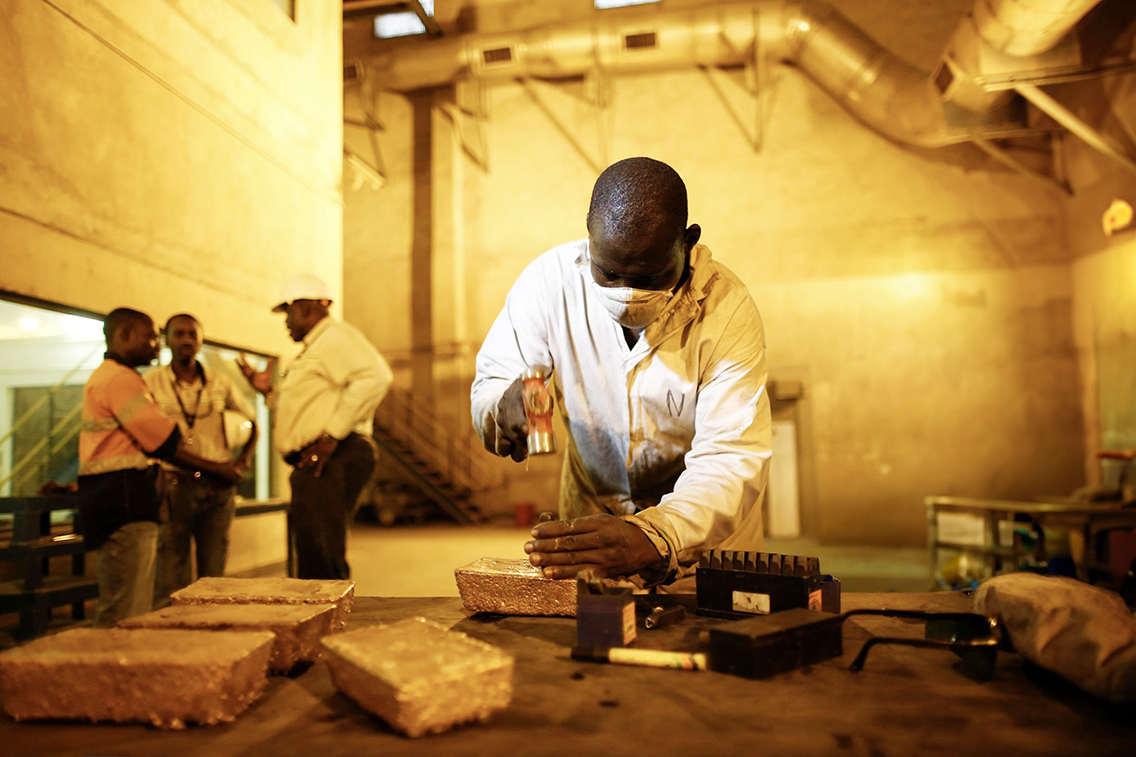
Africa’s minerals are at the centre of a global scramble, from gold’s record-breaking surge to the soaring demand for cobalt, copper, graphite and rare earths. Africa has entered a new era in the global minerals economy. Home to 30% of the world’s critical minerals, the continent has been seen as no more than a source of raw ores to distant industrial centres; but times are changing. Africa is now the focal point of a geopolitical, economic and technological scramble driven by the energy transition, the race for electric vehicles and the reconfiguration of global supply chains. From cobalt in the Democratic Republic of Congo to copper in Zambia and graphite in Tanzania, African minerals have become indispensable to the world’s decarbonisation ambitions.
The continent’s reserves are vast, its production is rising, and its strategic importance has never been greater.
And the story unfolding today is increasingly one of beneficiation, processing and industrialisation; a remarkable shift championed by African institutions such as the African Export–Import Bank (Afreximbank), which is investing heavily to ensure that Africa captures more value from its mineral wealth.
As global demand intensifies, African governments, financiers and private sector actors are pushing to transform the continent from a supplier of raw materials into a competitive hub for mineral processing, battery manufacturing and green industrialisation.
What gold’s surge means
This transformation is happening against the backdrop of a dramatic surge in mineral prices, particularly gold. In Morocco, the market value of mining company Managem soared from $6.1bn to $10.8bn on the back of a 55% rise in revenue, driven by surging gold and silver prices.
Gold miners from South Africa to Sudan are benefiting from a global flight to “safe haven” assets amid geopolitical uncertainty. Egypt’s gold boom, fuelled by new discoveries and artisanal production from Sudan, has reshaped the country’s mining landscape. Egypt’s gold sector is experiencing its most significant expansion in decades, a trend mirrored across the continent.
Gold’s rise is not merely a financial story. It is a macroeconomic lifeline. For countries battling currency depreciation, fiscal deficits and external shocks, gold revenues provide stability. In South Africa, rising gold prices helped strengthen the rand to its highest level in three years, buoying mining exports and lifting the valuations of giants such as AngloGold Ashanti and Gold Fields. In Sudan, despite conflict, gold remains the country’s most important export while in Morocco, gold has become central to the country’s mining expansion, with new projects in Tizert and Boto coming online.
Critical minerals and the energy transition
Gold is only a part of the story. The global energy transition has triggered unprecedented demand for critical minerals from cobalt to lithium, nickel to manganese, graphite to rare earths; all of which Africa possesses in abundance. The International Energy Agency estimates that demand for critical minerals will quadruple by 2040 under current trends including the adoption of electric vehicles.
The DRC supplies over 70% of the world’s cobalt. Zambia and the DRC together contain the copperbelt, now revitalised by record copper prices reaching $13,000 to $14,500 per tonne in early 2026. Tanzania is emerging as a graphite powerhouse and Morocco is becoming a key supplier of cobalt sulphate, signing a seven-year deal with Renault to supply battery-grade material.
These surges in demand have triggered a geopolitical scramble. Saudi Arabia, the United States, China, the European Union and India are all competing for access to African minerals. Samuel Ramani, associate fellow at the Royal United Services Institute thinktank and CEO of the Pangea Geopolitical Risk consultancy, tells African Business that “the critical minerals issue is something that is rising up Saudi Arabia’s list of priorities – they really want to present Saudi Arabia more muscularly in broader critical minerals supply chains.”
And the US and DRC announced a “strategic partnership,” saying it would ensure that “mineral resources are managed responsibly for the long-term benefit of the Congolese people as well as the people of the United States of America”.
Tresor Chovu, an advisory board member at the Critical Minerals Fund, an Africa-focused investor in the sector, tells African Business that this increased engagement is creating opportunities for the DRC and other African governments. “Governments in Africa have been looking to expand mining exploration projects but, if you look at the trends for the last 10 to 15 years, exploration money has been scarce. There have not been major early-stage exploration projects; most mining companies have simply maximised their existing mines and explored around existing production sites. This has been problematic for Africa.”
Afreximbank and the rise of beneficiation
African leaders are increasingly clear that the old model of exporting raw materials and importing finished goods is no longer acceptable. Africa’s critical minerals reserves are too valuable to be shipped out unprocessed. This is driving a wave of policy reforms, investment strategies and industrial partnerships across the continent.
Afreximbank, through its impact investment arm the Fund for Export Development in Africa (FEDA), has committed hundreds of millions of dollars to beneficiation and industrialisation. Its $300m investment in the Africa Minerals and Metals Processing Platform (A2MP) is a landmark intervention.
A2MP operates 12 mineral assets and four processing hubs across nine countries, focusing on gold, bauxite, alumina, manganese, iron ore and critical minerals. George Elombi, president and chair of Afreximbank and FEDA, captured the significance of this investment when he said: “with this investment, Afreximbank is helping the continent transition structurally from raw material exports to a fully integrated system of mining and local manufacturing.” His words reflect a strategic shift: Africa is no longer content to be the world’s quarry. Beyond A2MP, Afreximbank has committed $450m to ARISE IIP to develop industrial parks in Nigeria, Côte d’Ivoire, Chad, Kenya, the DRC and Malawi. These parks are designed to host mineral processing plants, battery component manufacturers and green industrial clusters.
A continental industrial awakening
The impact is already visible. In Guinea, new bauxite processing facilities are being developed to produce alumina domestically rather than export raw ore. In Zambia, rising copper prices have spurred investment in smelting and refining capacity, with the government pushing for local processing of copper cathodes and battery precursors. In Morocco, cobalt production is expanding rapidly, supported by partnerships with global automakers. In Tanzania, graphite processing plants are being built to supply the global battery industry. In South Africa, platinum group metals are being integrated into hydrogen fuel cell manufacturing.
These developments are reshaping Africa’s economic landscape. Countries that were once peripheral to global supply chains are now central nodes in the production of batteries and renewable energy technologies.
Zambia’s economy for instance is benefiting from record copper prices, with the IMF projecting growth of 4.3% in 2026. Malawi’s stock exchange surged 250% last year, partly driven by investor interest in mining and industrial firms. In Morocco the mining sector is also booming.
Africa’s industrial future
The scramble for African minerals is not without risks. Competition among global powers could create new dependencies. Environmental and social concerns must be addressed. But the opportunities are immense. Africa has the potential to become a global hub for green industrialisation: not just a supplier of raw materials, but a producer of battery components, refined metals and advanced technologies.
The path forward requires investment, policy coherence and regional integration. Afreximbank’s initiatives, from A2MP to industrial parks, are building the infrastructure and financing needed to support this transformation.
The question is no longer whether Africa will play a central role in the global minerals economy, but how much value it will create and capture.