
Let us begin with the names by which cotton is known across the continent of Africa to help underline its significance and potential. In Hausa, it’s auduga. In Yoruba and Igbo, owu. In Akan/Twi, asaawa. In Swahili, pamba. In Amharic, t’it’i. In Zulu and Xhosa, ukotini or ikotini or ilaphu depending on the context and in Afrikaans, katoen.
Across north, east and southern Africa, many of these names trace their etymology and linguistic roots to the Arabic word qutun – the origin of the English word “cotton”. Through centuries of trade across the Sahara and the Indian Ocean, qutun travelled, transformed and embedded itself in African languages and economies.
But cotton’s story begins long before Africa adopted the fibre. Archaeological evidence shows that cotton was independently domesticated in two parts of the world.
In Peru, cotton fabrics dating back to 6000 BCE have been found at Huaca Prieta. Meanwhile, in the Indus Valley, cotton cultivation and spinning began around 5000 BCE, with advanced textile manufacturing flourishing by 3000 BCE.
India became the Old World’s earliest and most sophisticated cotton producer. For millennia, Indian cotton was a luxury commodity traded across Egypt, the Middle East and Europe. It was soft, durable and unmatched in quality and so prized that it travelled the Silk Road and reshaped global fashion long before the word “fashion” existed.
Wealth, power and geopolitics
Cotton wasn’t just a fabric. It was wealth, power and geopolitics.
By the 18th and 19th centuries, cotton became the engine of the Industrial Revolution. Inventions such as the spinning jenny, the water frame and the cotton gin transformed production. Manchester became known as “Cottonopolis”, the beating heart of global textile manufacturing.
But this prosperity came at a devastating human cost – especially for Africa. Cotton’s dark history was at the centre of the transatlantic slave trade. Millions of Africans were captured, shipped and forced into labour to sustain the cotton economy.
Booming demand for raw cotton in British mills fuelled the expansion of plantations in the American South; plantations that were built on the backs of enslaved Africans. By the 1850s, the US South supplied 80% of Britain’s cotton, creating the era of “King Cotton”. Cotton became both an economic weapon and a political one. It shaped the American Civil War, triggered the “Cotton Famine” in Europe (a massive economic depression) and influenced independence movements from India to Egypt in very direct ways.
The echoes of that dark past continue to reverberate. In Nigeria today, some people use the word akata as a derogatory term for African Americans. While the literal Yoruba meaning refers to a fox, many African Americans interpret it as synonymous with “cotton picker” – a painful reminder of slavery and the cotton fields of the American South. The word does not literally mean “cotton picker”, but the association shows how deeply cotton is woven into the memory of black identity on both sides of the Atlantic.
Africa’s opportunity
Now, let’s turn to the future – and Africa’s opportunity. How can Africa transform past pain into future prosperity?
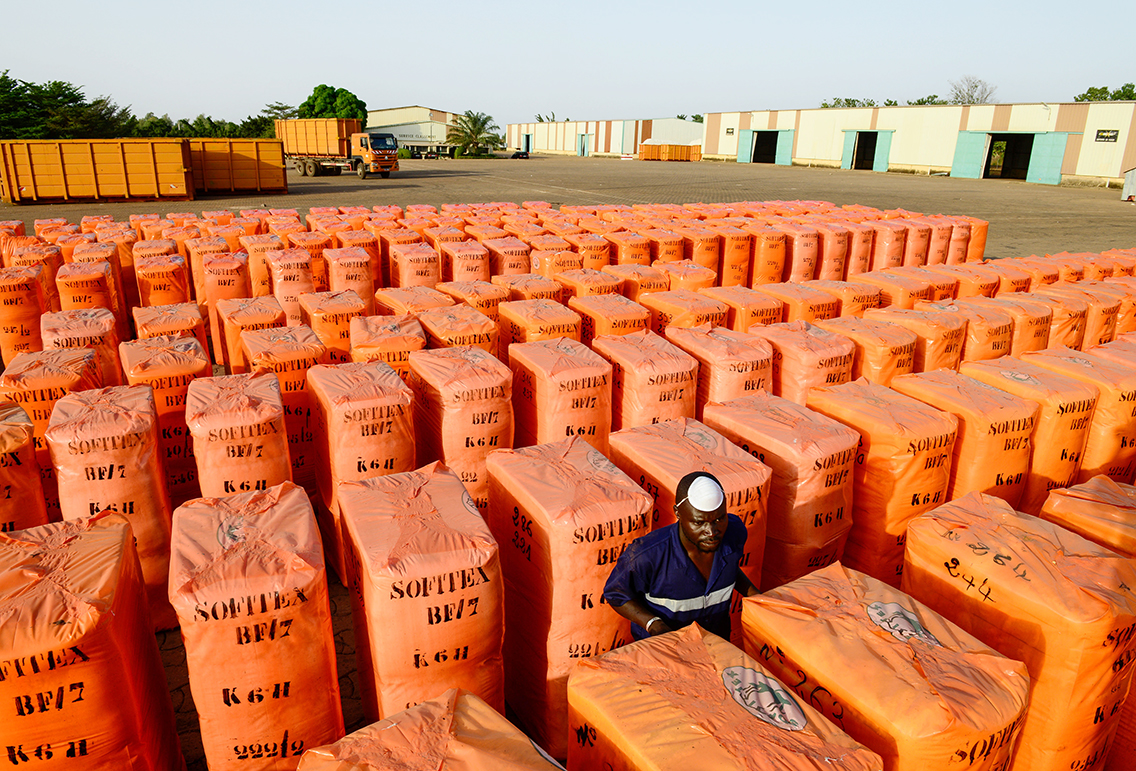
Africa grows about 2.6m tonnes of cotton annually, with major producers including Benin, Mali, Burkina Faso, Tanzania and Egypt.
Yet the continent captures less than 10% of the cotton value chain. Africa exports raw cotton worth about $15bn but imports $50bn worth of finished textiles every year. What this means is that only 12% of Africa’s cotton exports are in the form of yarn and 18% as fabrics, while about 70% is exported as raw, low-value fibre.
This is where the opportunity lies. If Africa processes its cotton by spinning, weaving, dyeing and manufacturing garments, the continent could unlock hundreds of thousands of jobs, reduce textile imports and build a globally competitive fashion and textile industry.
A $5bn plan
Institutions such as Afreximbank are leading this renaissance. The Bank is collaborating with ARISE IIP, Rieter and the Africa Textile Renaissance Initiative in the $5bn Africa Textile Renaissance Plan, which aims to create 500,000 tonnes of cotton transformation capacity and 500,000 jobs by building integrated industrial parks, modernising ginneries and supporting African designers.
This plan is especially important in the light of uncertainty regarding the future of the US’s (AGOA) which prioritised textiles in the tariff-free trading mix. (The Trump administration let AGOA lapse in September 2025, then eventually extended it, but only until 31 December 2026).
The goal is simple: T-shirts, denim, uniforms and fashion pieces made in Africa – from African cotton.
Imagine a future in which African cotton doesn’t leave the continent raw, but as a finished product with African labels, African jobs and African value.