The World Cup’s core intent has always been to unify the globe through football. This year’s edition seemed primed to reinforce that sentiment more than ever – taking place across three nations and raising the number of participants to 48 from the traditionally established 32 – both firsts in the tournament’s 96-year history.
But from the moment the United States was confirmed as the primary host of the 2026 World Cup, fans and critics were alarmed. One of the first acts of the first Trump administration was a travel ban covering nearly forty countries; something in direct tension with the basic premise of a global football tournament.
The international football federation FIFA produced assurances that the US State Department had promised that all eligible athletes, officials and fans from qualified nations would be permitted to attend. In reality, these assurances have proven shaky.
According to regulations set before the tournament, residents of Algeria, Cabo Verde, Senegal, Côte d’Ivoire and Tunisia are required to pay bonds of $5000 to $15,000 in order to obtain tourist visas to the United States. No exemption was granted to fans attending the World Cup.
On 13 May the US State Department announced that it would waive this requirement for some World Cup attendees. But the New York Times pointed out that this was not as useful as many headlines suggested. It applied only to those who had both purchased World Cup tickets and opted in to the FIFA “priority appointment scheduling system” (FIFA PASS) by 15 April – despite the bond being required on that date.
US policy thus still placed attendance beyond the reach of the vast majority of supporters, already expected to pay an average of $765 per ticket for the group stage matches alone.
The national teams of Senegal and Côte d’Ivoire are competing at the tournament without an organised supporters’ contingent after visa applications submitted by some fans were rejected by US consular officials.
Somali referee shown the red card
The treatment of Omar Artan stands out. Awarded Men’s Referee of the Year by the Confederation of African Football (CAF) in 2025, he was the first Somali referee to oversee a continental final, at the 2024-25 CAF Champions League. He was selected by FIFA as one of 52 officials to officiate at the World Cup, in a historic event for a country whose footballing structures have spent decades rebuilding from the ruins of prolonged conflict.
Artan was denied entry into the United States at Miami International Airport. US Customs and Border Protection forces disregarded his diplomatic passport and deemed him “inadmissible due to vetting concerns”.
Artan told the New York Times that he was interviewed for 11 hours, asked why he had travelled to the US and questioned about Somali politics and the al-Shabaab terrorist group. After showing official FIFA documentation alongside photos from his refereeing career, he was put in a holding cell then put on a plane to Istanbul, from where he took a connecting flight back to his hometown of Mogadishu.
“I think that they have a problem with my country,” Artan told the newspaper.
A US official, speaking anonymously, claimed that Artan had links to suspected members of terror organisations, an accusation that Artan has denied.
FIFA president Gianni Infantino called the situation “unfortunate”. Former US secretary of state Hillary Clinton described the decision as “counterproductive” and “terribly backward”. World Health Organization director-general Tedros Adhanom Ghebreyesus said Artan had reached the summit of his profession as Africa’s best referee, adding that the “milestone stands no matter what”.
FIFA subsequently confirmed that Artan would be “fully remunerated for his commitments at the World Cup”. The estimated $100,000 payout will be a small consolation for the injustice and embarrassment.
Europe’s governing body for football, UEFA, has invited Artan to officiate at the 2026 UEFA Supercup match between Paris Saint-Germain and Aston Villa on 12 August.
DR Congo’s Ebola debacle
Fans from the DR Congo already had a hard enough time with funds and visas. Then US authorities decided that members of the country’s delegation must be isolated for 21 days before being permitted to enter the United States, citing the latest Ebola outbreak in the country. At the time of writing this had passed 1115 confirmed cases, of whom 304 have died.
Andrew Giuliani, executive director of the White House Task Force for the World Cup, confirmed the team must maintain a bubble at their training base in Belgium or risk being denied entry to the US. That put a significant burden on a squad whose players are based at European clubs across France, England, Belgium and beyond.
After qualifying for their first World Cup in half a century the squad eventually arrived in the United States after serving the quarantine period and being forced to cancel their pre-tournament training camp in their home country.
Vozinha’s mother left behind
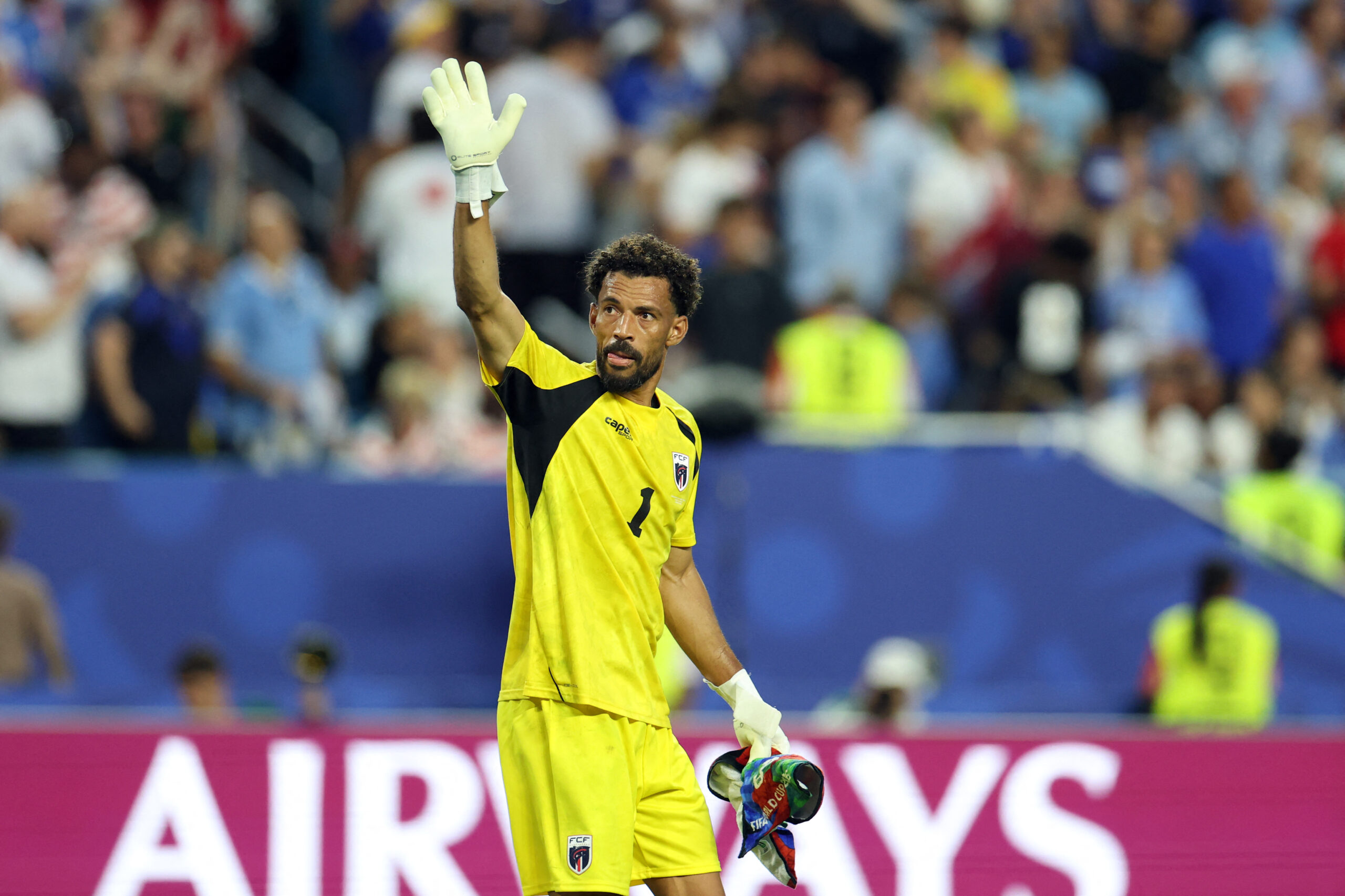
Vozinha (pictured), the 40 year old Cabo Verde shot-stopper, made seven saves and global headlines as his country held Spain to a historic 0-0 draw on 15 June in Atlanta, one of the tournament’s most stunning results. It was Cabo Verde’s first-ever men’s World Cup appearance. But his triumph was overshadowed by the inability of his elderly mother, Ana Candida Evora, to attend the game due to visa expenses.
“She didn’t manage to be here because of the money you have to pay for the visa, we didn’t manage on time, and I would like her to be here,” Vozinha told reporters.
US House minority leader Hakeem Jeffries wrote directly to secretary of state Marco Rubio urging him to intervene, stating that “No mother should miss the chance to see her child make history.” Vozinha’s mother was eventually granted a visa ahead of Cabo Verde’s 2-2 draw with Uruguay and was able to watch her son play live.
The ball is in FIFA’s court
FIFA chief Gianni Infantino defended his organisation’s conduct over the visa debacles. “We don’t live on the moon, we live on planet Earth,” he said.
“We have to respect that we are not kings of the world, who can rule over governments and police forces. We are a sports organisation that does as much as we can. It’s important sometimes to chill, relax. We work on everything. Sometimes screaming and shouting does not find a solution.”
But there is palpable frustration that the governing body has not been able to do more to tackle the visa issue and ensure that African supporters and personnel can attend the World Cup.
The decision to award a World Cup to a country that had already announced travel bans affecting multiple qualified nations, while accepting non-binding assurances that have not been enforced, continues to cast a pall over the tournament.