
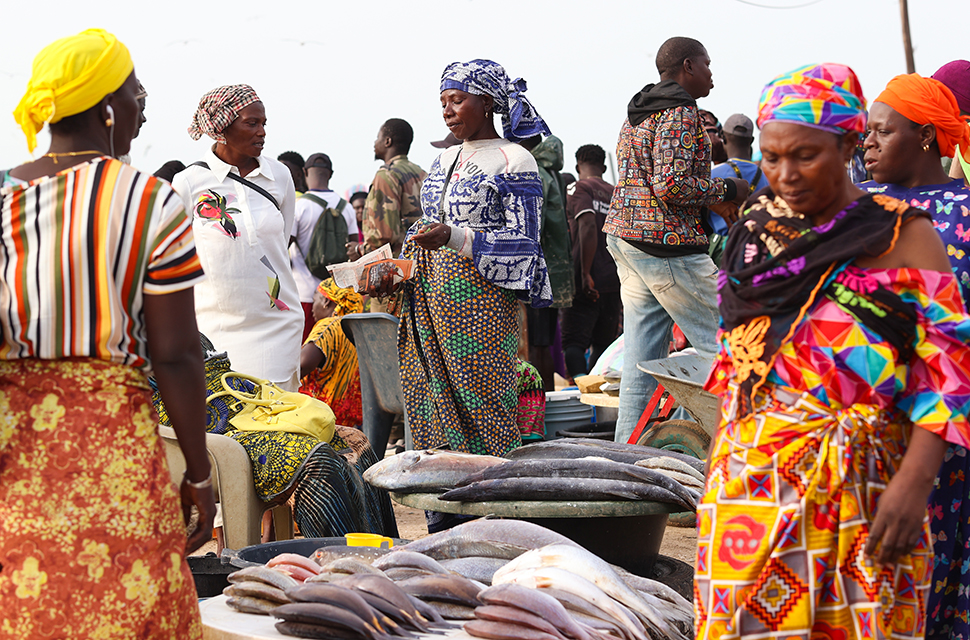
On the Aflao border crossing between Ghana and Togo there is a formal customs station that is open for business virtually around the clock. About 200 metres away from the customs station is an unmarked dirt path that only local people know about, where the action really happens.
This is where women carry smoked sardines and similar fish, in large metal pans or buckets on top of their head, and they navigate through narrow spaces in the bushes to get to the other side of the border. They fill out no forms, wait in no lines, and simply walk.
This is what happens every day on the Ghana-Togo-Benin route; this is where it all takes place. This is the structure upon which rests an underground economy. Approximately 6,000 metric tons of processed fish move through the informal trade routes each year.
This isn’t about randomness or lawlessness. The reason for the success of this highly organised, self-sustaining network is simply that the government does not provide a viable alternative. While politicians debate policy and build fancy terminals, these women have built their own working system.
The muscle for this network is women traders who are very strongly organised and continue to dominate each level of the fishing trade – from processing at the coast of Ghana to selling at market locations in Togo and Benin.
Significant volumes are transported into Togo and Benin annually, with women doing the vast majority of the work.
Fish makes up 61% of what households spend on animal products in Ghana and it represents 70% of all the protein from animals that people eat in Ghana. In Togo, fish represents 40% of what people consume for protein.
Official checkpoints are often the source of long lines and harassment by officials who demand bribes in exchange for allowing passage. Studies have shown that many traders (especially those selling lower-margin goods) such as women selling smoked fish, can lose all of their profit due to the informal fees levied and which range from 5,000 to 10,000 CFA francs or about $8 to $16.
As a result, they have to adjust to this situation. The traders do not use primary routes through their travels, but instead they take secondary, or neighbourhood, travel routes as well as pedestrian paths to circumvent immigration checkpoints altogether.
They rely on informal networks of relatives and friends who have functioned on both sides of the colonial border dividing the Ewe people since 1890. In addition to paying no money at barriers for their passage, they have created an unofficial alternative to formal border crossing systems.
Ama Serwaa, who has been crossing this border for 20 years, trades in small but much-liked smoked sardinella. “The official gate is broken down,” she says, balancing her bowl while walking. “I’ve been on this road so long that I know it. I know the people. I can negotiate with my sister in Lomé. This is how trade is supposed to work.”
When borders close, informal networks open
Almost all experts believed that when Ghana and Togo officially shut down their border at the start of March 2020, almost all trade would stop. Researchers from the University of Bergen and Ghana’s CSIR-Food Research Institute also investigated how those involved in the trade kept fish flowing across the border.
Because women who would normally go across the border into neighbouring countries couldn’t cross the border, they asked for help from family members they knew and trusted to get things back and forth. They lent money to partners on the opposite side of the border. Many also shared information about which unofficial crossings still operated.
The two-year-long border closures did nothing to stop the fish trade that flowed between countries. When the two countries opened the borders again in March 2022, they found that the cross-border trade networks that existed between the countries were not only still there, but had also become even larger. According to researchers, the reason behind this is the fact that the social relationships of fish traders (that is, their informal economy) were a determining factor in maintaining the resilience of the cross-border trade system.
The governance void
Why do these informal systems exist? The reason lies within the breakdown of local government. Although local authorities are provided with the power to provide markets, road access and all sorts of basic services to their residents via metropolitan, municipal and district assemblies, most of these authorities do not have the capacity to provide such services.
The District Assemblies Common Fund (DACF) was designed to provide district assemblies with an element of fiscal autonomy. The DACF has historically been late in releasing funds and in many cases has also released less money to those assemblies than was originally budgeted for. Historically, district assemblies have received no more than 40-50% of what they were originally funded for prior to this time.
When the local government fails to fix a road or cannot maintain a market place, traders will normally find alternative methods to resolve their problems. The traders create their own routes. They also create their own marketplaces.
Delayed funding, for example by local government, “stalls project execution”, undermines the ability of local authorities to plan, and diminishes the public’s trust in such authorities, says Alhaji Osman Abdel-Rahman, Executive Director of the Ghana Developing Communities Association.
The Ghanaian government is addressing this. In September 2025, President John Dramani Mahama stated that assemblies will receive 80% of all funds allocated to them directly, rather than the 40-50% previously allocated. Over the years of inaction, the informal sector has created its own solution.
Across the Ghana-Togo border, informal trade has become an unintended means of using unofficial currency traders in place of formal (official) banking institutions to fulfil a void created because the Ghanaian cedi cannot be converted into the West African CFA franc via the official exchange system.
According to economist Bright Simons, this explains the disconnect between the official exchange value and the actual exchange value in Ghana’s marketplace.
The Bank of Ghana’s official currency exchange rate for the dollar is around C10.10. However, the black-market or ‘parallel’ market rate ranges from C11.5 to 12.5 per dollar. Merchants in Ghana have learned how to profit from this spread. Using their Ghanaian debit cards, many of the merchants travel to Togo and use those cards at ATMs to withdraw CFA francs. Upon returning to Ghana, they then convert the CFA francs into dollars and sell those dollars on the black market.
As Simons says, “This is not illegal. It’s standard economic behaviour. Nothing out of the ordinary about it.” It is just normal behaviour by informal traders when formal systems do not have sufficient flexibility to provide them with access to liquidity.
What formalisation gets wrong
For years, both national governments and international donor organisations have promoted the ‘formalisation’ of the informal sector. However, most of these efforts have been unsuccessful. The informal sector is not an illegal underground economy operating outside the legal system; it is a separate economic system which has developed to function in addition to the formal one, since the formal economy does not fully work.
ECOWAS recognises that informal trade is important. Intra-African trade depends on such informal networks for as much as 30-40% of its total. While there are simplified trade regimes in theory, the implementations are poor. For example, at the joint border posts at the Aflao border, which are designed to help simplify the international crossing, many traders have reported being harassed by officials and required to pay bribes.
The recent changes made in the decentralisation system in Ghana are a good move forward for the government. It was reported that as soon as the Korle-Klottey Municipal Assembly was allowed to collect its own taxes, the amount of money collected by the assembly increased from C2m to C12m. If local governments have the ability to control their own finances, they will be able to provide financial assistance to the marketplaces and the type of roadways that merchants require.
Back at the Aflao border crossing, the woman with the smoked fish in the basin has already crossed into Ghana. She will sell her goods in Lomé, negotiate prices in two currencies, and return home before nightfall. Today, the woman who did this was able to move food, generate an income and feed family members from both sides of the border.
She is not going to wait for decentralisation to be implemented. She has developed her own method. Until the local government can develop an operational model as efficient as hers, she will continue using hers.
The African informal economy’s success in creating a strong, resilient, and thriving engine for economic growth in Africa stems from an ironic source: its greatest weakness. That weakness is the poor or no-governance issue that plagues the continent. This weak governance has caused the informal economy to grow through innovation.
For the policy makers there is little debate. They may continue to pursue the creation of a formally regulated economy and institute a host of regulations that will be ignored, or they may correct the governance gaps that created a regulatory environment that makes it more profitable to operate in the informal economy.
Women in Ghana at Aflao have already made their decision. They have created something that works. Now it is time for governments to create something that works too.
Abubakar Ahmed analyses the intersection of governance and economic development.