

Across Africa, policymakers increasingly agree on one point: the continent’s economic transformation will depend not only on investment in infrastructure or natural resources, but on the skills of its people. Technical and Vocational Education and Training (TVET) systems have therefore become central to development strategies, from renewable energy and agriculture to tourism and manufacturing.
Yet despite growing recognition of the importance of skills, many TVET systems across sub-Saharan Africa continue to face structural challenges. Training programmes are often poorly aligned with industry needs; lecturers have limited opportunities for professional development; and institutions struggle to update curricula to match fast-changing labour markets.
International collaboration is increasingly seen as one way to bridge these gaps. Among the initiatives working in this space is the British Council’s Going Global Partnerships programme, which supports collaboration between UK institutions and TVET providers around the world. Since 2009, the programme has facilitated more than 200 international skills partnerships between UK training providers and institutions in over 40 countries.
Across Africa, these partnerships are focusing on three major priorities shaping the future of skills development: green technologies and sustainability; entrepreneurship and employability; and inclusive leadership in the education sector.
While many of the projects operate on a relatively small scale, advocates say their impact lies in strengthening institutions, improving pedagogy and building long-term relationships that can help drive systemic change.
“Through knowledge sharing, capacity building and reciprocal visits, partners work together to improve training delivery, strengthen employer engagement and enhance the employability of graduates,” the British Council says.
The partnerships are also designed as two-way exchanges of knowledge rather than a traditional development programme. UK institutions gain insights into emerging markets and new educational approaches, while African institutions gain access to international expertise and networks.
Across the continent, case studies show how these collaborations are beginning to reshape how vocational training is delivered.
Aligning training with industry needs
One of the persistent weaknesses of many TVET systems is the disconnect between education providers and employers. Training programmes sometimes focus on theoretical knowledge rather than practical skills demanded by industry.
Strengthening employer engagement has therefore become a central goal of many international partnerships.
In Tanzania, collaboration with UK colleges has focused on bringing industry closer to the training process. Partnerships between UK institutions and Tanzanian vocational centres have helped introduce new models of employer participation in curriculum design and work-based learning.
For example, visits to UK training institutions exposed Tanzanian partners to apprenticeship systems where employers actively shape programmes. The experience encouraged vocational centres in Tanzania to strengthen links with construction firms and tourism businesses.
These collaborations are already leading to tangible outcomes. Training institutions have begun to integrate more practical learning opportunities and industry-led input into their programmes.
Anthony Kasore, director general of Tanzania’s Vocational Education and Training Authority (VETA), says such exchanges are critical to improving quality. “Through these partnerships, we have significantly enhanced our vocational training offer and built the capacity of teaching staff through exposure to international best practice,” he says. “Such collaborations are instrumental to improving the quality of Tanzania’s TVET system.”
The green skills revolution
Another major focus across many partnerships is the development of green skills.
Africa’s economies are rapidly adapting to new climate realities while also exploring opportunities in renewable energy, sustainable agriculture and green construction. Governments therefore need workers with the technical expertise required for emerging sectors.
In several countries, TVET partnerships are helping integrate sustainability into vocational training programmes.
In Malawi, collaboration between UK institutions and local technical colleges has focused on green construction practices. Workshops and mentoring have helped colleges design new curricula that teach students environmentally sustainable building techniques and resource-efficient construction methods.
The project has also explored new public-private partnerships aimed at ensuring training aligns with industry needs. One proposal emerging from the partnership is the creation of a Green Skills Advisory Panel, bringing together government, employers and educators to guide curriculum development.
Meanwhile, in Mauritius, efforts have focused on strengthening training in green technology and renewable energy. Training providers worked together to identify gaps in existing programmes and develop new courses ranging from electric vehicle charging infrastructure to energy storage systems.
By introducing micro-credentials and specialised training for lecturers, the project aims to ensure that institutions can keep pace with rapidly evolving technologies.
Across the continent, similar initiatives are emerging in agriculture. Sustainable farming techniques, climate-resilient production and environmental stewardship are becoming key components of agricultural training programmes.
These changes reflect a wider recognition that climate change is reshaping Africa’s labour markets and economic priorities.
Preparing graduates for entrepreneurship
In many African economies, formal employment opportunities remain limited. For this reason, vocational training is increasingly expected to equip graduates not only with technical skills but also with the ability to create their own businesses.
Several international partnerships have therefore focused on embedding entrepreneurial skills within technical training programmes.
In Ghana, for example, collaboration between UK colleges and technical universities has helped redesign parts of the curriculum to encourage innovation and enterprise.
Initial research conducted by the partners revealed that while entrepreneurship was included in programmes, it was often taught as a minor component towards the end of courses.
Students therefore had little opportunity to apply business skills in real-world contexts.
To address this gap, educators developed new teaching resources and training programmes aimed at helping lecturers integrate entrepreneurial thinking throughout technical courses.
These efforts have already produced new initiatives such as an entrepreneurial hub, designed to support graduates who want to launch businesses.
For many policymakers, such approaches are essential if TVET is to play a larger role in tackling youth unemployment.
“By integrating entrepreneurship and sustainability into the curriculum, we are preparing students for real-world challenges,” says Vincent Uys, a lecturer involved in a similar initiative in South Africa. “It’s no longer just about producing crops – it’s about producing successful agricultural businesses.”
Addressing gender gaps in leadership
Despite growing numbers of women entering vocational training programmes, leadership positions within TVET institutions remain heavily male-dominated in many countries.
Some partnerships are therefore focusing specifically on female leadership development.
In Malawi, a leadership programme brought together female educators from technical colleges and government agencies to strengthen their management skills and confidence. Participants completed an eleven-module programme covering areas such as leadership practice, change management and coaching. Each participant also developed a project aimed at improving opportunities for women within the TVET sector.
For many participants, the programme offered both practical training and a valuable peer network.
Graduates reported increased confidence in leadership roles and a stronger commitment to advocating for gender equality within their institutions.
Such initiatives are increasingly seen as essential for building inclusive education systems capable of supporting broader economic transformation.
Small partnerships, systemic change
While each partnership operates within a specific sector or institution, their broader objective is to strengthen entire skills ecosystems.
This involves improving teaching methods, developing new curricula and creating stronger links between training providers, employers and policymakers.
Many projects rely on a train-the-trainer approach, ensuring that knowledge gained by a small group of lecturers can be shared across institutions.
Reciprocal visits between partner countries also play a key role. These exchanges allow educators to observe different training systems, build relationships with industry and explore how successful approaches might be adapted to local contexts.
Importantly, the partnerships are designed to continue beyond the life of individual projects.
Memoranda of understanding, ongoing staff exchanges and collaborative networks are intended to ensure that cooperation continues long after initial funding ends.
In some cases, these collaborations are already expanding into new areas, such as joint research, student mobility programmes and curriculum development initiatives.
The road ahead for African TVET
Africa’s population is expected to reach nearly 2.5bn by 2050, creating both immense opportunities and significant challenges for labour markets.
Developing effective vocational education systems will therefore be critical for enabling young people to access meaningful employment.
International partnerships alone cannot solve the structural challenges facing TVET systems. Sustainable progress will require national investment, policy reform and stronger engagement from the private sector.
However, initiatives such as the Going Global Partnerships programme demonstrate how targeted collaboration can support institutional reform and knowledge exchange.
By linking educators, policymakers and industry partners across continents, these partnerships are helping build the foundations for more responsive and inclusive skills systems.
For Africa’s rapidly growing workforce, the stakes could not be higher. The ability of training institutions to equip young people with relevant, future-focused skills will play a decisive role in shaping the continent’s economic trajectory.
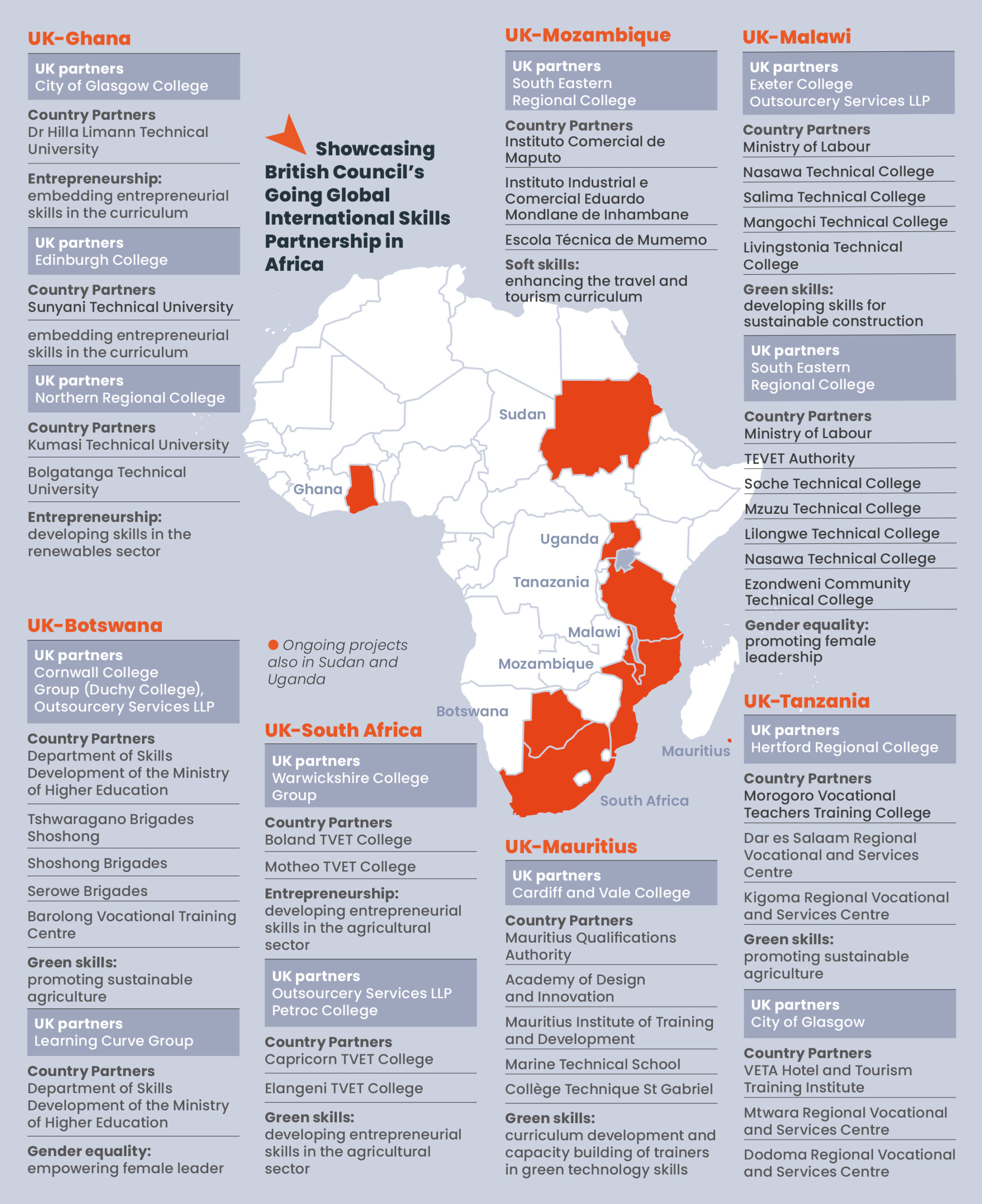
South Africa: Entrepreneurship and renewable energy
South Africa’s partnerships have focused on agriculture and renewable energy.
Training programmes introduced entrepreneurial frameworks into agricultural courses, helping students develop business skills alongside technical knowledge.
At the same time, collaboration on renewable energy training has enabled colleges to design new short courses focused on green technologies and sustainability.
These initiatives aim to equip graduates with the skills needed to participate in emerging sectors while also encouraging job creation through entrepreneurship.
Botswana: Greening agriculture and empowering women
In Botswana, partnerships have focused on two major priorities: sustainable agriculture and female leadership.
UK institutions collaborated with agricultural training centres and brigades across the country to strengthen curricula and introduce sustainable farming practices. Workshops and mentoring programmes helped lecturers integrate environmental sustainability and entrepreneurship into agricultural education. At the same time, another partnership supported female TVET professionals in obtaining leadership qualifications aligned with international management standards.
The initiative enabled 13 women to complete a diploma in leadership and management, equipping them with the skills to take on more senior roles within Botswana’s vocational education sector.
Malawi: Green construction and female leadership
Malawi’s partnerships have addressed two key priorities: environmental sustainability and gender equality in the TVET sector.
Green construction initiatives have helped technical colleges develop new curricula focused on sustainable building techniques and environmental awareness.
Meanwhile, leadership training programmes for female educators aim to address the under-representation of women in senior positions within the sector.
Together, these initiatives are supporting Malawi’s efforts to build a more inclusive and environmentally sustainable skills system.
Tanzania: Strengthening links with industry
In Tanzania, partnerships have focused on improving employer engagement within TVET.
Collaboration with UK colleges helped vocational centres in construction and tourism strengthen relationships with industry partners and introduce more work-based learning.
Training workshops and reciprocal visits exposed lecturers to apprenticeship models and employer-led curriculum design, enabling institutions to develop more industry-relevant programmes.
New courses have also emerged from the collaboration, including specialised training in areas such as baking using local produce.
Mozambique: Building soft skills for tourism
Mozambique’s growing tourism sector requires workers with both technical knowledge and soft skills such as teamwork and problem-solving.
Partnerships between UK institutions and technical colleges in Mozambique introduced project-based learning approaches that allow students to apply their skills in real-life contexts.
The initiative strengthened teaching methods, improved collaboration between institutions and helped trainees develop practical skills needed in the hospitality and tourism industry.
Ghana: Entrepreneurship and green technology
In Ghana, partnerships have worked with technical universities to strengthen entrepreneurial education and develop training in renewable energy technologies.
New teaching tools and training programmes have helped lecturers embed entrepreneurial thinking across technical courses, while collaborations with UK institutions have introduced expertise in hydrogen technologies and renewable energy systems.
The initiatives are helping universities prepare graduates for both employment and self-employment in emerging sectors.
Mauritius: Building a green technology curriculum
Mauritius has focused on strengthening training in renewable energy and green technologies.
Working with UK partners, training institutions developed new micro-credentials and curricula covering areas such as energy storage systems and electric vehicle infrastructure.
The initiative aims to support the country’s ambitious renewable energy targets while also expanding career pathways in green industries.