
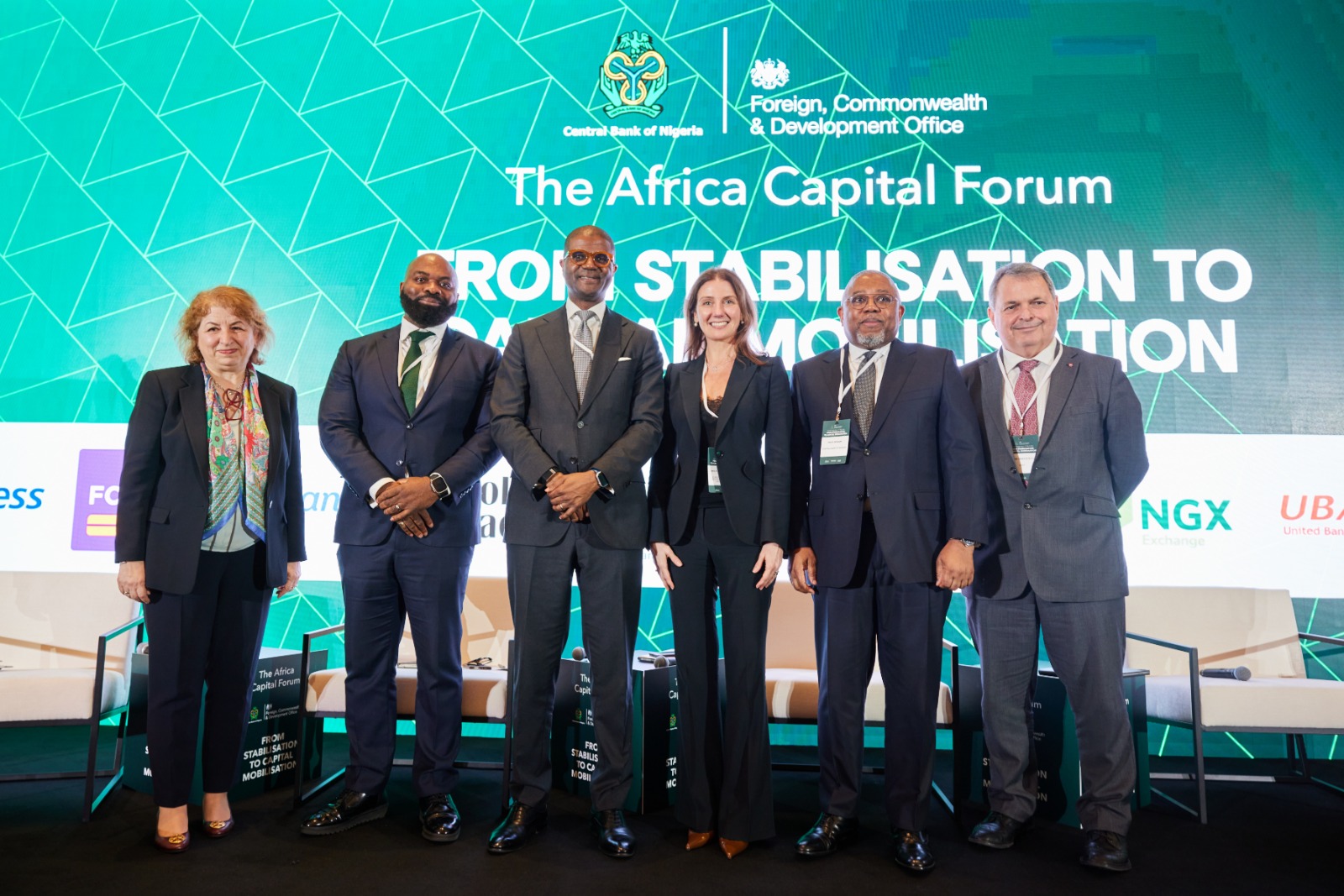
While Nigeria’s ongoing macroeconomic reforms are attracting renewed attention from investors, speakers at a panel discussion during the Africa Capital Forum in London, England argued that it is long-term, committed capital that will spur job creation, infrastructure development and large-scale industrial projects. This, it was agreed, will require long term commitment to structural reforms to diversify the economy beyond extractive industries, strengthen human capital, deepen capital markets and enhance fiscal transparency.
Commenting on the bank’s much touted reforms, Phillip Ikeazor, deputy governor for financial system stability at the Central Bank of Nigeria, said the true test of reform credibility lies in whether policy changes translate into tangible, everyday improvements for citizens and market participants. He argued that recent reforms are beginning to yield dividends as their impact becomes more visible across the economy, particularly in easing access to foreign exchange and improving transaction efficiency.
He added that the breadth of the reform programme makes it more likely to endure beyond the current policy cycle. “That is the power of reform,” he said, noting that once reforms begin to take effect, they create a natural constituency that reduces the risk of reversal and reinforces long-term policy credibility.
Chris Chijiutomi, head of Africa, British International Investment plc, emphasized the critical role of long-term institutional capital in driving sustainable economic development in Nigeria. While acknowledging the importance of foreign portfolio investments as a signal that the market is open and ready for business, Chijiutomi noted that in times of global uncertainty such as current events in Iran, “it is typically the first type of capital to exit.”
Chijiutomi contrasted this with the impact of patient, long-term investments. “At BII, we’ve committed over $700m into Nigeria over the last 77 years, investing through cycles. When you think about sustainable development and job creation, it is this type of long-term capital that can give you that.”
Speaking from the perspective of a new institutional investor in the country, Melis Ekmen Tabojer, managing director, policy strategy and delivery at the European Bank for Reconstruction and Development (EBRD) stressed the importance of structural reforms in sustaining long-term institutional investment in Nigeria. She emphasized that while Nigeria has made significant strides through macroeconomic reforms long-term investors also look closely at structural fundamentals.
Tabojer stressed the need for Nigeria to expand its economy beyond extractive industries, pointing to the country’s vibrant digital and creative sectors as positioning it as an innovation hub for the region. “Nigeria is the largest country and has the largest human capital as well and we really need to see it from that perspective as well,” she pointed while urging investors to seek on the ground assessments so they can “distinguish between perceived risk and real risk”.
On the cost of capital for long-term investments in Nigeria, Steve Gray, head of west and central Africa, UK Export Finance (UKEF), argued that “full fiscal transparency is the way to drive down costs,” noting that the lack of reliable data for Nigeria as well as other African countries makes it difficult to properly price risks. “Transparency allows the risk adjusters to price it accurately and reflect that in the pricing. Reforms have clearly changed the fundamentals, but those reforms need to be proved through communications,” he argued, adding that Nigeria could leverage the credit quality of institutions such as the UK’s ECA to enhance its borrowing profile.
Olimpia Gjino, regional head of syndications (EMEA) at International Finance Corporation (IFC), offered the World Bank institution’s decade-long engagement with Nigeria as proof of its investability. The IFC, she said, is working to mobilise private capital for investment, noting that hard currency financing remains an important option. “Money is pooled in developed markets, but opportunities are in the emerging markets and Nigeria is no different. What investors want is predictability and convertibility of currency.”Gjino stressed that only deeper hedging opportunities will make more local currency financing available to the region.