

Africa’s long-standing struggles with energy access are coming into sharper focus than ever at the start of 2026. Just four years remain until 2030, the deadline for achieving the continent’s goal of bringing electricity to 300m people under the Mission 300 initiative championed by the World Bank and African Development Bank.
“2026 is a decisive execution year,” says Martijn Proos, co-head of emerging market alternative credit at investment manager Ninety One. “The priority must be to move from high-level commitments under Mission 300 into a steady flow of bankable projects that can be financed and built at scale.”
Some 32m new connections have already been attributed to the World Bank’s Mission 300 efforts. At the start of 2026, however, African leaders are not content with basic electricity connections. The need for reliable sources of baseload power to fuel industrialisation is also an increasingly urgent priority. The continent has opportunities to bring in billions of dollars from critical minerals – but maximising these benefits will depend on building energy-intensive processing industries.
While almost everyone agrees that efforts to bridge Africa’s power gap will need to accelerate in 2026, there remains much disagreement on the best path forwards.
Solar surges
If there is one certainty about the year ahead, it is that solar power will bring far more megawatts of power capacity to Africa than any other energy source. Consulting firm Rystad Energy anticipates that 17 GW of new electricity capacity will be added around the continent this year – of which 9 GW will come from solar sources. Several records will be broken as huge new solar projects come on stream. Dubai-based AMEA Power is developing Africa’s largest single-site solar and battery energy storage system (BESS) project in Egypt’s Aswan Governate. The project, which combines 1 GW of solar panels with 600 MWh of BESS, is set to come into commercial operation in June.
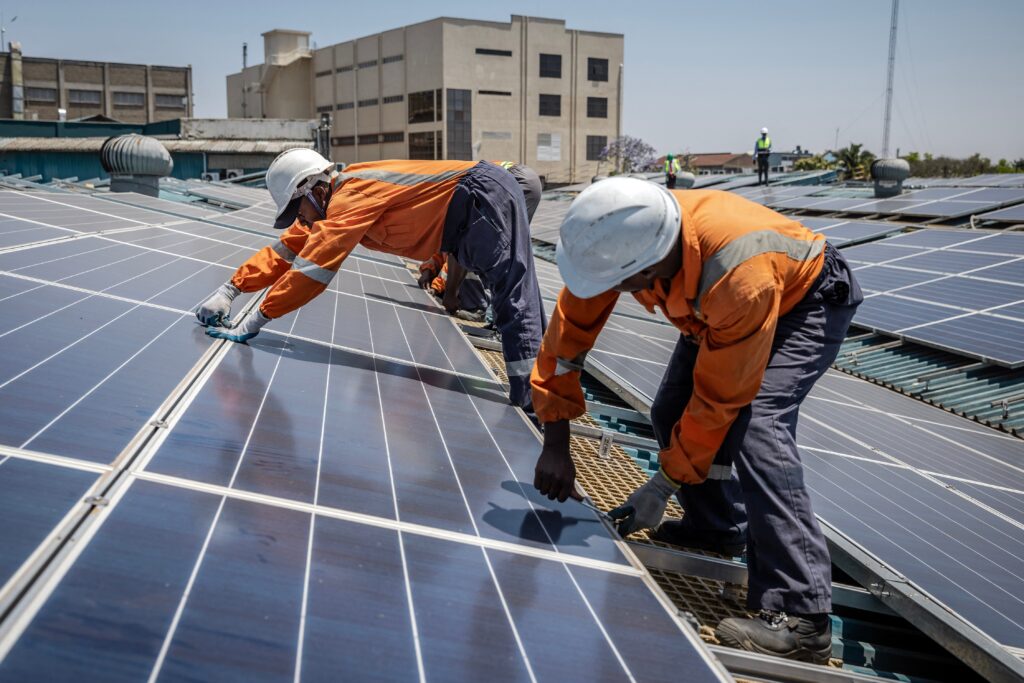
Equally significant is the growth of rooftop solar. This trend is already well-established in South Africa. During the depths of the country’s load-shedding crisis, households and businesses increasingly began to take matters into their own hands by installing rooftop panels. This reduced their reliance on expensive diesel generators during the lengthy periods when state-owned utility Eskom was unable to provide power.
One of the key questions for the year ahead is how far the rooftop revolution will be replicated around the continent.
There are, in fact, tantalising signs that solar panels are sprouting on Africa’s rooftops much more quickly than is captured in official statistics. Data collected by think tank Ember shows that imports of solar panels from China to the continent (excluding South Africa) grew by 60% in the 12 months to June 2025.
The Africa Solar Energy Association (AFSIA) notes that these figures “fundamentally” change the picture on solar power in the continent, suggesting that capacity could be almost three times as high as previously believed.
“Rooftop solar progress in Africa is poised for continued acceleration in 2026,” says Nivedh Das Thaikoottathil, senior analyst at Rystad.
“Falling module prices make rooftop viable for C&I [commercial and industrial users] and residential users, out-competing diesel generators and grids in outage-prone areas.” The reasons why solar is set to extend its lead as Africa’s main source of new power capacity in 2026 are not hard to understand.
Africa has more than 60% of the world’s solar resources. The costs of solar panels and batteries continue to fall, while there is plenty of supply available because of overcapacity in Chinese factories.
Even so, the successes of solar in Africa should not be exaggerated. AFSIA highlights how the rate of growth in solar capacity is faster in Africa than any other region of the world, at 17% in 2025. Yet this still leaves Africa with, at most, 2.6% of global installed capacity.
Speaking to African Business at COP30 in November, Ashish Khanna, director-general of the International Solar Alliance and one of the architects of Mission 300, expressed frustration at the slow pace of solar investment in Africa. The continent is dramatically lagging behind the likes of China and India, he warns.
“I still feel too many people are talking about what needs to be done, for too long,” he says. “These countries do not need lectures on what needs to be done. We want implementation, partnerships and the experience of power.”
Khanna argues that solar is a “critical part” of Mission 300, but acknowledges that an unplanned surge in rooftop solar will bring complications. “Most distribution companies do not want solar on rooftops,” he says, noting this can upend their business models.
The solution, he argues, is for African countries to invest in modernising grids and promoting storage alongside rooftop solar. “We believe that it is very important to first plan your grid, to have distribution investments to allow for a lot of rooftop solar,” says Khanna.
A fossil fuel revival?
Despite the progress with renewables, especially solar, many African leaders continue to look to fossil fuels as the keys to economic development.
Rashid Abdallah, executive director of the African Energy Commission, argues that developing gas will be key to bringing electricity access and industrial development.
“The African narrative on energy is completely different from the global narrative. From Africa, we need to use all the resources available in the African soil – being renewable, being non-renewable – to fill the gap of energy access.”
“I’m expecting that natural gas will become a main energy player in 2026 and beyond,” he says, pointing to discoveries in Mozambique, Tanzania, Senegal and Mauritania that could prove to be a “game-changer” for the continent. Some advocates describe liquefied natural gas (LNG) as a “transition fuel” which can bridge the gap between high-emissions fossil fuels and renewables.
The coming year is indeed likely to be a strong one for the continent’s oil and gas sector. Energy consultancy Wood Mackenzie expects oil production to exceed 6m barrels this year – the highest figure since 2015.
Several high-profile projects are set to come onstream soon. Uganda will join the ranks of Africa’s oil producing nations when fields operated by French company TotalEnergies and the China National Offshore Oil Corporation (CNOOC) become operational. Oil from the two fields will be exported via the East African Crude Oil Pipeline, which runs through Tanzania. Meanwhile, Total is close to restarting development work on its massive LNG project in Mozambique after it lifted a force majeure declaration late last year. The stoppage was imposed in 2021 due to an Islamist insurgency.
What is less certain is whether other major projects will progress into the development phase, especially in countries such as Namibia that are not established producers. Turning the reserves of oil and gas discovered in recent years in the deep waters off the coast of Namibia into producing assets would cost billions of dollars. The development bill is heightened by the lack of existing infrastructure. Yet with global oil demand already close to peaking, and a glut coming into the global LNG market, the decision on whether to develop costly new projects is finely balanced.
Projects in established producing countries such as Nigeria and Angola are typically easier and less costly. In the gas sector, S&P Global estimates that Africa’s share of the global LNG market will grow from 7% today to 13% by 2050. Meanwhile, it says gas-to-power demand will rise by 4.5 times, as the continent increasingly looks to gas to fire its industrialisation ambitions.
Demba Diallo, managing director at infrastructure investment platform Africa50, highlights how his institution is making a range of investments in renewables projects, but also insists that gas-fired generation needs to be part of the continent’s energy mix. “We have to use our own resources,” he says. “It’s also a matter of economy, and if you don’t use what you have, then you have to import what you don’t have.”
He notes that some European sources of finance remain “restrictive”, reflecting governments’ reluctance to see development finance institutions invest in fossil fuels. But overall, Diallo says lenders are becoming more “realistic” about backing gas. In particular, he notes that using liquefied petroleum gas as a fuel for clean cooking could help to replace more polluting sources and reduce emissions.
The long-awaited African Energy Bank, capitalised initially with $5bn, is on the cusp of beginning operations from its new headquarters in Abuja. The institution, jointly established by the African Petroleum Producers’ Organization and the African Export-Import Bank (Afreximbank), is intended mainly to help finance oil and gas projects on the continent.
Hopes and realities
Karabo Mokgonyana, campaigns and energy adviser at the non-profit Power Shift Africa, says the Trump administration’s efforts to promote oil and gas worldwide “has changed the narrative on the continent”.
US energy secretary Chris Wright called last year for an “all-of-the-above” energy strategy in Africa – which, in practice, has taken the form of downplaying the role of solar and wind and promoting the role of US energy companies, especially in the oil and gas sector.
Mokgonyana says the US position chimes with the instinct to favour oil and gas in some African capitals, especially in countries like Nigeria where “elites” have benefited enormously from oil and gas revenues.
Alongside gas production, several African countries are exploring how to use imported LNG to benefit their industrialisation efforts. An LNG import terminal is being developed in Guinea, intended largely to power the processing of minerals in the country.
It is likely, however, that the practical difficulties in rolling out new gas-fired generation will become more apparent in 2026.
The chief problem currently is that, amid a worldwide surge in demand for gas-fired generation (driven partly by power-hungry data centres in the United States), there is a huge backlog in gas turbine orders. Several Asian countries looking to expand gas-to-power capacity face a wait of around five years for the equipment to be delivered.
The reality, therefore, is that harnessing gas remains a lengthy process and that Africa will need to also pursue alternative power sources.
Alternative energy
While solar and gas will take centre stage in Africa’s energy landscape in 2026, several other technologies will also play an important role. The most developed renewable energy markets on the continent, including South Africa, Morocco and Egypt, are all developing wind energy as a complement to solar.
Hydropower remains a key source of power in many African countries, although only a handful of new projects are under construction. Angola’s Caculo Cabaça scheme is expected to begin contributing power by late 2026, while Zambia and Zimbabwe are seeking to arrange finance for the Batoka Gorge project that will help power the local mining industry.
DR Congo’s long-mooted Inga 3 dam received a boost last year with a promise of World Bank funding, although realising the megaproject will be a long-term process.
Nuclear power, meanwhile, is set to play a bigger role in the continent in the years to come. Construction is well underway at the El Dabaa nuclear power plant in Egypt, set to be just the second on the continent. The first of four reactor vessels was delivered in late 2025, ahead of an expected 2028 commissioning.
The World Bank’s recent decision to end its ban on funding nuclear power opens the doors for more African countries to join the nuclear club. Kenya and Ghana have the most advanced regulatory frameworks for nuclear power on the continent, having each identified sites for future power stations. Given the lengthy development timelines, however, Kenya’s hopes of beginning construction as early as next year may prove overly ambitious.
Finance frustration
Regardless of the source of energy, developers will need to overcome long-standing bottlenecks in securing finance in 2026.
“The primary challenge this year remains the high cost of capital, often driven by unfair risk perceptions and credit ratings that do not reflect the actual viability of African energy projects,” says Carol Koech, vice president for Africa at the non-profit Global Energy Alliance for People and Planet.
She adds that unattractive regulatory environments and inefficient utilities continue to “quietly erode investor confidence and project bankability”.
Koech does highlight how Africa’s sources of finance are becoming more diversified, with developers increasingly looking to tap into the $2 trillion managed by African pension funds, sovereign wealth funds and development banks. “This focus on domestic capital will reduce dependency on bilateral aid models and mitigate the foreign exchange volatility that often hinders project sustainability.”
The next twelve months will not solve all Africa’s problems in the energy sector. The slow pace of converting both renewable and non-renewable resources into sources of power will inevitably remain a source of frustration in the year ahead.
Yet there are signs of real progress, particularly as the trickle of solar panels appearing on African rooftops grows into something more like a flood. The sense of urgency in tackling the access gap has never been greater. For the hundreds of millions of people who continue to live without electricity, the time for waiting patiently is over.