
Mining
Even as the government focuses on diversification, the country continues to generate enormous interest in its mining sector. Significant investments in tin, copper and cobalt and increasingly, lithium, are flowing in from countries such as China, the UAE and Kazakhstan.
From 2019 to 2023, the DRC received about $13.56bn in investment commitments under its Investment Code – with the extractive sector being the largest recipient.
According to the UNCTAD World Investment Report 2024 the DRC attracted about $1.63bn in foreign direct investment (FDI) in 2023, with the extractive sector driving a large share.
The rising clamour for product beneficiation in Africa is also being heard in the DRC, with a new partnership between NG9 Holding and Congolese company Buenassa announcing in 2025 plans to build the DRC’s first integrated copper-cobalt refinery to produce copper cathodes and cobalt sulphate.
This aligns with the DRC’s goal to move up the critical minerals value chain, with initial funding and government support already in place for studies.
Banking and finance
Banking is becoming an investment sweet spot for multinational organisations from neighbouring countries especially with returns on equity in Congolese banks much higher than the continental average. Reforms and better regulation have strengthened transparency and governance, making investment even more attractive to prominent banks like Kenya’s Equity Group, which acquired Banque Commerciale du Congo (BCDC) in 2020 and KCB Group, which acquired Trust Merchant Bank in 2022.
South Africa’s banking giant, Standard Bank, is operating in the DRC while Absa has a foothold via a partnership with Rawbank, the country’s biggest bank, and is considering a more permanent presence as it explores opportunities linked to the Lobito Railway project. Nigerian banks also have a long-standing presence in the market, including FirstBank of Nigeria, Access Bank and UBA, as well as Ecobank.
The opportunity for growth is very considerable, because fewer than one in 10 people have bank accounts in a population of 114m.
Logistics
The Lobito Corridor Project, linking the DRC’s resources to the Atlantic Ocean through Angola, has the power to transform the country’s trade with global markets while easing its logistical challenges. It includes the rehabilitation and extension of the Benguela railway from the Angolan port of Lobito through Zambia and into the DRC’s mining heartland, including Kolwezi and Lubumbashi.
The aim is to move copper, cobalt and other minerals to global markets, hitherto routed through East Africa and even Durban in South Africa, some 2,700 km away. In early 2026 the Africa Finance Corporation (AFC) announced the signing of major financing agreements for the Lobito Atlantic Railway Project in Angola.
The project has secured a $753m financing package, comprising: $553m from the US International Development Finance Corporation (DFC) and $200m from the Development Bank of Southern Africa (DBSA).
When operational it will reduce the distance between the Kolwezi mining area and a seaport from 3,000 km (to Durban, South Africa) to 1,600 km to Lobito, and secure Western supply chains for critical minerals, reducing dependence on routes controlled by Chinese interests. The corridor will facilitate the development of a local industrial value chain, enabling the DRC to add value to its minerals, and has the potential to boost agriculture and other industries in the provinces of Haut-Katanga, Lualaba, Haut-Lomami, and Tanganyika.
The Kasumbalesa Dry Port is a $600m logistics hub concession agreement with South African consortium, Yellowstone, to build and operate a new facility at the border crossing of the same name on the Zambian border.
The crossing is a vital lifeline to the ports south and east of the DRC from the main mining areas around Kolwezi and Lubumbashi but suffers from many logistical, capacity and bureaucratic issues that have severely compromised its efficiency over the years.
The Likasi–Solwezi Corridor will link the mining hubs of Likasi in Haut-Katana province and Solwezi in Zambia’s North-Western Province. It includes the development of a 160 km paved road and a dry port.
The Banana Port is part of a broader push to open the DRC to Atlantic maritime trade. It is a deep-water project led by DP World and the Portuguese engineering and construction firm Mota-Engil in a public-private partnership with the government.
Energy
Energy is another economic priority area. Installed electricity capacity is about 3,200 MW, mostly hydroelectric. However, less than 70% of this is operational due to ageing infrastructure and maintenance challenges. Access to power is low, with only about 20% of the population connected to the grid, almost all of them in urban areas.
A slew of energy projects are underway to address this from The Grand Inga Hydropower Complex to the DRC-Zambia Power Interconnector, a 190 km 330 kV electricity transmission line supported by the International Finance Corporation as well as the Afreximbank-backed 200 MW hydropower plant on the Lufira river.
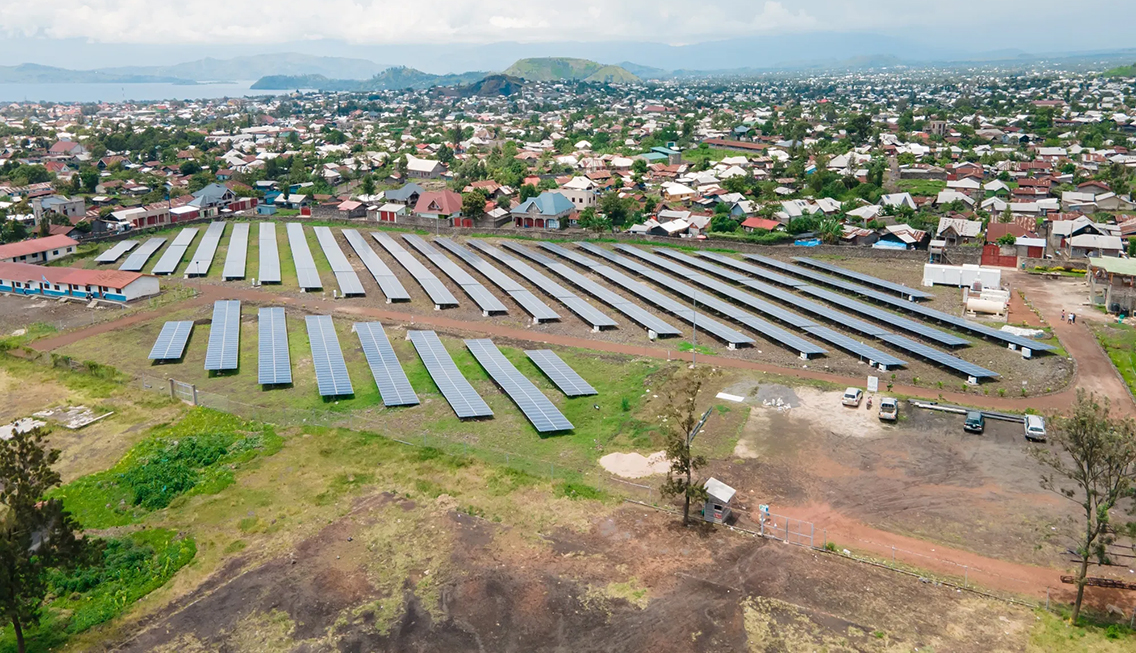
Renewable energy is now part of the mix with Afreximbank making its first investment in the sector through a large solar project.
The Africa Finance Corporation is diversifying the DRC’s energy mix with participation in the DRC Green Giant Project, a large-scale, 1,000 MW solar power initiative under development in a partnership with Canadian solar developer SkyPower Global.
A 233 MW solar photovoltaic plant is being built for the Kamoa-Kakula mining complex by Sungrow and CrossBoundary Energy and is expected to start commercial operation this year.
Digital
Expanding digital infrastructure, connectivity and internet penetration is one of four key goals of the 2026–2030 National Digital Plan, which seeks to position the DRC as a regional digital hub. To support the strategy, the government plans to invest $1bn over five years, alongside $500m in external funding from international partners.
Mauritian company United Investment LMT has an ambitious $150m plan to roll out 60,000 to 80,000 km of fibre optic cable nationwide, install a new 192-terabit-per-second submarine cable, and construct three data centres.