

A host of African leaders enjoyed the winter warmth of the Gulf in mid-January as they jetted into the United Arab Emirates for the Abu Dhabi Sustainability Week. South Africa’s Cyril Ramaphosa, Nigeria’s Bola Tinubu and Mozambique’s Daniel Chapo were among the heads of state to join this year’s edition of the annual event.
The fact that the sustainability summit in the Emirati capital has become the latest fixture on the diplomatic circuit for African leaders is not surprising, given the importance of the Gulf nation to Africa’s energy ecosystem.
The UAE, a nation of just 11 million residents, has become among the largest – if not the largest – source of foreign investment flows into Africa in recent years. Emirati companies have been particularly active in the fast-growing renewable energy sector. According to UAE government figures, out of $110bn of Emirati investment in Africa between 2019 and 2023, some $70bn has flowed into renewable energy and green infrastructure.
“The UAE is opening its arms everywhere. We are a centre in between Asia and Africa,” says Hussain Al Nowais, chairman of AMEA Power, a Dubai-based company that is one of the largest renewable energy investors in Africa. The limited size of the domestic market means Emirati companies are naturally drawn to explore opportunities overseas, including in Africa, he adds.
Alongside the UAE, companies and investment firms from other Gulf Cooperation Council (GCC) states such as Saudi Arabia and Qatar have also been increasingly active in the African renewables space in recent years.
The Gulf states may have built their vast wealth on the back of their oil and gas industries, but they are fast becoming key players in the world of renewable energy. In Africa, their lead in the renewables race has become so vast that it is questionable whether anyone else can catch-up.
Megaprojects
Al Nowais, who spoke to African Business at the International Renewable Energy Agency (IRENA) Assembly in Abu Dhabi, says his company’s success in Africa comes down to the simple ability to match supply with demand.
“Many years ago, when I started this company, we saw scarcity of power and a shortage of power in some of the countries we visited in Africa,” he says. “We realised that could be an opportunity, and we jumped on it.”
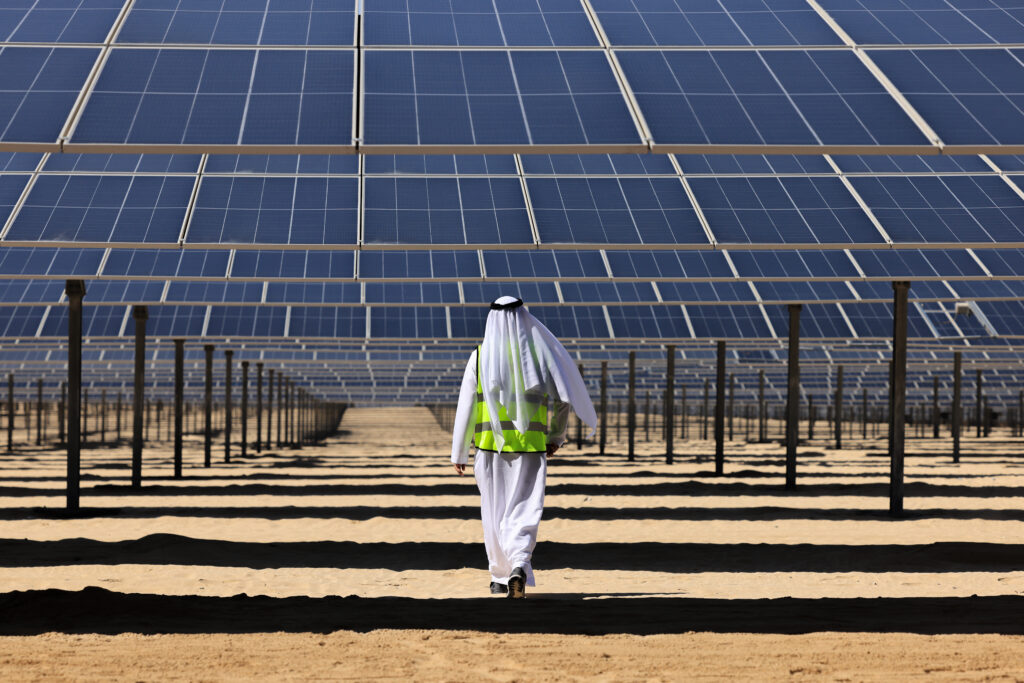
After entering the continent with a solar project in Togo, AMEA Power has expanded into multiple other African countries. Its largest market is now Egypt. The company has several solar, wind and battery storage projects in the North African country. This includes a new site in the Aswan Governate that will be Africa’s largest single-asset renewable and storage project, with 1 GW of solar power and 600 MWh of battery storage.
Al Nowais notes that AMEA Power is increasingly focusing on larger projects, in countries such as Egypt and South Africa, where it is possible to achieve greater of economies of scale. “We are refraining now from doing 20 MW or 25 MW, because it’s the same headaches we get, whether it’s 20 or 200 or 300,” he says. “So, we prefer to focus on larger scale projects.”
Other major Gulf-based renewables developers are showing enormous ambition in Africa, although some of the biggest players also tend to focus on the African countries with the most developed energy markets. Saudi Arabia’s ACWA Power, for example, has assets in Morocco, Egypt and South Africa. Its CEO, Marco Arcelli told African Business in 2024 that achieving scale is difficult on the continent outside these markets.
Abu Dhabi-based Masdar has taken a somewhat different approach by targeting a broader range of countries. It has assets in countries including Mauritania, Senegal and the Seychelles, and has signed partnership deals with several others such as Angola, Uganda and Zambia. The company announced in late 2023 that it aims to build 10 GW of renewable power across Africa by 2030, an endeavour that will require a $10bn financial mobilisation.
Financial firepower
The decision of several African presidents, along with a much larger cohort of ministers and officials, to attend Abu Dhabi Sustainability Week and associated events such as the IRENA Assembly highlights how the Gulf is fast becoming a key place to look for renewables finance.
Demba Diallo, managing director at infrastructure investment platform Africa50, says the Gulf is playing an increasingly important role in financing projects. “We are talking more to GCC investors now than what we used to do,” he says. “We have seen a lot more this past three or four years.”
“If you look at Africa50, we have been partnering with the likes of Masdar, AMEA Power in the UAE, and also the Qatar Fund for Development,” says Diallo, who praises the pragmatism and long-term thinking of these Gulf-based partners.
The GCC boasts several of the world’s largest sovereign wealth funds, including Saudi Arabia’s Public Investment Fund, the Qatar Investment Authority and the UAE’s Mubadala, ADQ and Abu Dhabi Investment Authority. These institutions have all, to varying degrees, proved eager to finance green infrastructure projects in Africa.
Qatar has focused in particular on financing critical minerals projects in Africa that are vital for the global energy transition. Qatari investment firm Al Mansour Holdings signed a spate of multi-billion-dollar MoUs with countries including DR Congo, Zambia and Mozambique last year, pledging to help finance mining projects and associated energy infrastructure.
While there is no shortage of capital in the Gulf, Diallo says African infrastructure funds need to offer the right structures to be able to attract commitments from the region. He notes that it is important to deploy African capital into these funds as a way of demonstrating “allied interests”.
And Diallo says traditional partners, such as European development finance institutions, remain crucial in contributing the concessional tranche to blended finance structures. These structures can then look to attract Gulf-based institutions that seek a commercial rate of return.
“This is a good combination,” he says. “Project development is risky, so you have to have blended capital.”
Building a renewables ecosystem
While the UAE’s investment in African renewables is dominated by large-scale developers and financial institutions that deliver megaprojects, the country has also increasingly emerged as a hub for players that focus on the opposite end of the African market.
Ignite Energy Access is an example of an Africa-focused renewable energy company that has chosen to base itself in the UAE. The company, which was known as Ignite Power prior to its acquisition of Engie Energy Access from its French parent company in 2025, was previously headquartered in Mauritius before formally relocating to Abu Dhabi last year.
Unlike companies that work on megaprojects, Ignite is focused on expanding energy access through distributed renewable energy systems. It offers off-grid power connections for as little as $1 per month. Its CEO, Yariv Cohen, says the company has already connected 20 million people and is aiming to reach 100 million by 2030, accounting for a third of the overall electricity access target under the Mission 300 initiative.
The rural homes and small businesses in Africa where Ignite is operating could not be further away from the glitz and glamour of the Gulf. But Cohen says his team concluded the Emirati capital was the “best place” from which to operate.
“If you have a business that caters to the Global South, the UAE is the place to be,” he says, listing “talent, legislation, ease of operation, connectivity” as the Gulf state’s key attributes.
Cohen adds that Abu Dhabi, which also hosts the headquarters of IRENA, has been eager to support the growth of his business. The Abu Dhabi Investment Office announced a strategic collaboration with Ignite as part of its relocation, pledging to support the company in scaling its operations.
Even before relocating, Ignite received the prestigious Zayed Sustainability Prize from the UAE government at COP28 in Dubai in 2023 – recognition that Cohen says has been vital in the company’s take-off.
“We are operating in a market where you need to show the client, the governments, the World Bank, that you’re credible. And that prize gave it to us,” he says, pointing out that the company is now eight times bigger than when it received the award.
Bridging the Gulf
The reality that the UAE, and to a lesser extent other Gulf states, are playing an outsize role in the African renewables energy industry might seem disconcerting to some. There was a minor controversy in 2021 when Africa Oil Week was moved from Cape Town to Dubai, but so far there has no similar backlash against Emirati predominance in Africa’s renewables sector.
Another reality is that Africa needs the Gulf’s expertise, technology and investment if it is to achieve its electricity access targets and unleash its energy potential.
For now, at least, there is every reason to believe the Gulf-Africa renewables relationship will move from strength to strength.