
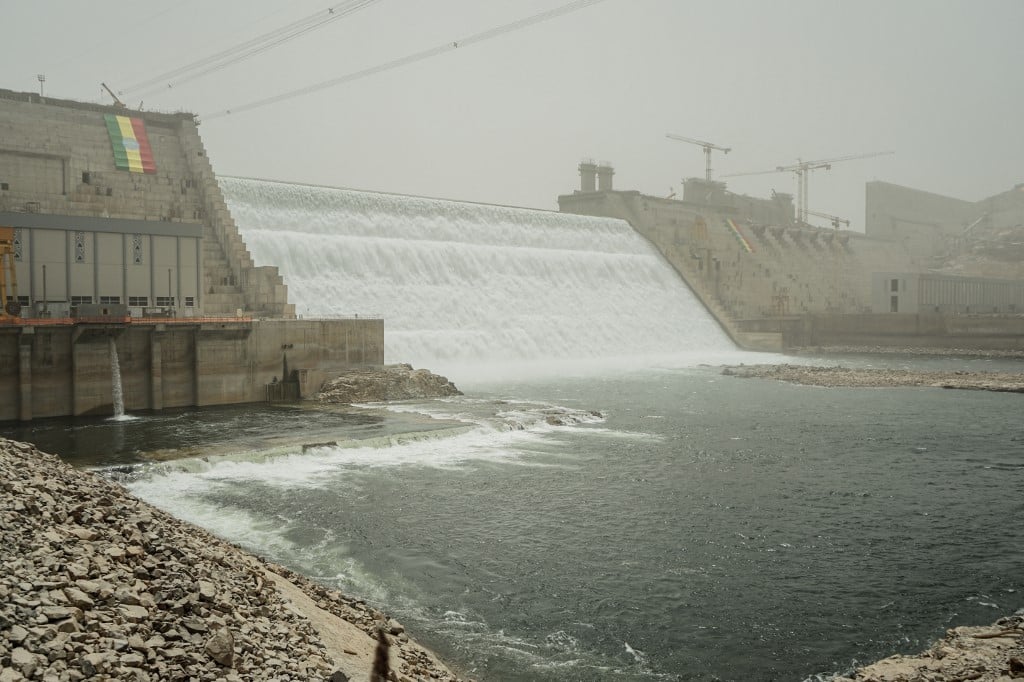
US President Donald Trump has reinserted himself into the long-running tensions between Egypt and Ethiopia over the controversial Grand Ethiopian Renaissance Dam, the largest hydropower scheme in Africa.
In a letter sent on 16 January to his Egyptian counterpart Abdel Fattah El-Sisi, Trump offered the services of US mediators in resolving Cairo’s bitter disagreement with Ethiopia over how to manage the waters of the River Nile.
Ethiopia’s construction of the GERD, which was officially completed in September 2025, has upended Egypt’s ancient dominance over the Nile. Now that the dam is complete, Ethiopia has the ability to control the flow of the Blue Nile, the branch of the river that accounts for around 85% of the water that passes into Egypt.
Egypt fears damage to its agricultural sector if Ethiopia restricts the flow of water from the dam, and is concerned that excessive releases – as allegedly happened in late 2025 – could cause flooding. Electricity generation at the Aswan Dam in Egypt could also be affected by fluctuations in water levels.
Trump’s letter appeared to back the Egyptian position, with a statement that: “The United States affirms that no state in this region should unilaterally control the precious resources of the Nile, and disadvantage its neighbors in the process.”
The US president went even further when meeting El-Sisi in Davos on Wednesday, claiming the dam has blocked Egypt from receiving water it has “gotten for a million years”.
Addis Ababa has so far offered a muted response to Trump’s latest intervention.
“Unless Ethiopia signals willingness to re-engage, it’s unlikely to shift the fundamentals of the dispute or lead to any breakthrough,” says Ahmed Morsy, a visiting fellow at the Middle East Council on Global Affairs.
Call for negotiations
The US president frequently lists the Egypt-Ethiopia dispute as one of at least eights “wars” he has already solved during his second term. In fact, the two countries have never fought over the GERD, nor has Trump so far succeeded in resolving their disagreement.
If the threat of force was ever on the table, this now looks like a fanciful prospect. Egyptian politicians were caught in a leaked recording discussing strikes on the facility during its early phase of construction back in 2013, though it is unclear how seriously the military option has ever been considered in Cairo.
But with the dam complete and its reservoir filled, destroying the GERD would unleash severe flooding downstream in Sudan and possibly even Egypt itself. The effects would resemble the damage caused by Russia’s destruction of the Kakhova Dam in Ukraine in 2023, though on a far larger scale.
Trump’s suggestion for a way forward is that the two sides, along with Sudan, negotiate a deal to “guarantee predictable water releases during droughts and prolonged dry years”.
This would go hand-in-hand with allowing Ethiopia to “generate very substantial amounts of electricity” that might be “given, or sold” to its downstream neighbours.
While this might sound a pragmatic approach, the devil will be in the detail. Years of on-off talks have so far failed to yield a lasting agreement governing the release of water. Meanwhile, the idea of Ethiopia supplying electricity to Egypt is complicated by the fact that this would entail transmitting power through Sudan, which is currently mired in a brutal civil war.
Finding a compromise
Whether Ethiopia can resist Trump’s pressure to make a deal with Egypt remains to be seen.
“Egypt is in a weaker position but still has some meaningful leverage,” says Morsy, who points to Egypt’s diplomatic engagements and regional alliances that help it shape global narratives on water security. “Ethiopia may control the dam, but Egypt can influence the political and legal environment in which it operates.”
Even though Trump has swung behind the Egyptian position, the reality is that Ethiopia – having completed construction – now holds a powerful set of cards. Much of whatever leverage the United States had over Ethiopia was lost last year when the gutting of USAID resulted in $387m in funding being withdrawn.
Addis Ababa remains reticent about accepting restrictions on how much water it can hold or release at the dam, since this would affect GERD’s electricity generation capacity.
Thanks in part to the 5 GW available from the GERD, the country has a historic opportunity to close its domestic electricity access gap, fuel its industrialisation and consolidate its role as a major regional electricity exporter.
“For Ethiopia, the dam isn’t just a power project; it’s a national economic cornerstone,” says Morsy.
As well as supplying power to neighbouring Kenya and Djibouti, Ethiopia has started to ‘wheel’ power through Kenya’s electricity grid to export electricity to Tanzania. Preliminary talks have even taken place on exporting power across the Red Sea to Saudi Arabia.
Ethiopia also posits the GERD as a symbol of national unity. It has been funded largely with domestic resources (despite Trump’s unexplained claim that the US in fact financed most of the construction).
Prime Minister Abiy Ahmed described the dam as “the greatest achievement in the history of the black race” at its commissioning ceremony last year.
For El-Sisi and Trump, compelling Abiy to agree to a compromise will be like pushing water up a hill. Any agreement on GERD would need to involve Addis Ababa swallowing its pride and taking a hit to what it regards as vital national interests.