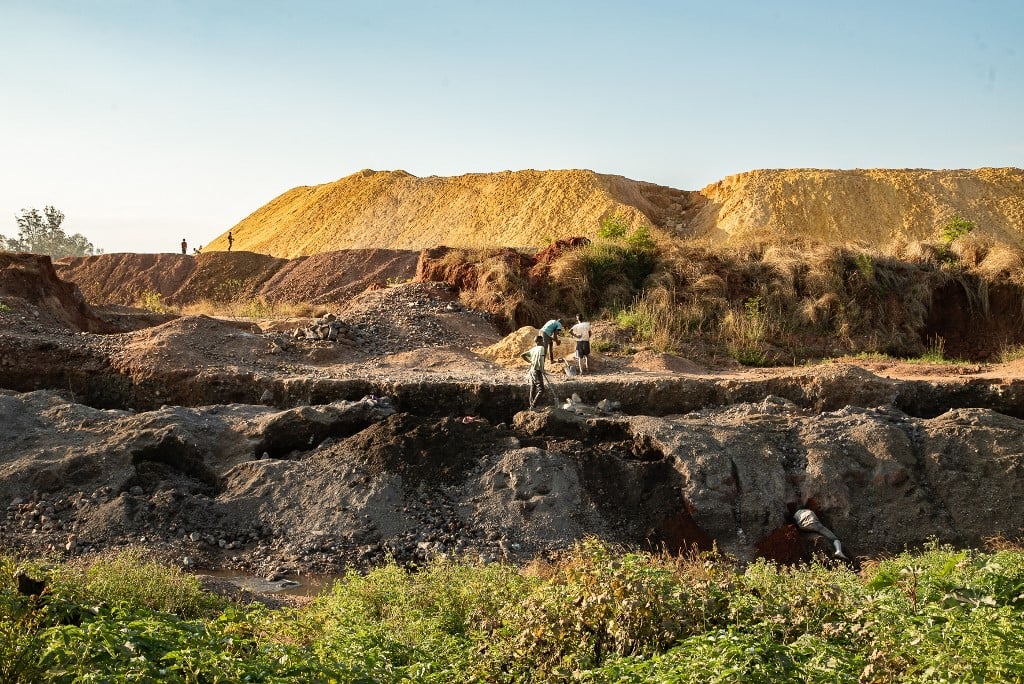
It was lauded as the “deal of the century” when, in 2007, two state-owned Chinese firms agreed to commit billions of dollars in infrastructure spending to help the Democratic Republic of the Congo (DRC) build its way out of the rubble of civil war. In exchange they received lucrative mining contracts worth $9 billion.
Railways, roads, and hospitals were promised as part of the Sicomines project, a joint venture between China Railway Group, Chinese state-owned engineering firm Sinohydro, and President Joseph Kabila’s government’s state mining company Gécamines, which held a 32% stake in the project.
As part of the deal, the Chinese firms acquired a lucrative 68% stake in two copper and cobalt mines in the Katanga province, as global demand for metals soared.
But the consortium has delivered little in terms of infrastructure, while the Sino-Congolese mining contracts are being scrutinised as part of a major investigation into the biggest leak in African banking history, known as the Congo Hold-Up saga.
Emails, bank statements, contracts, bills and corporate records make up the 3.5m internal documents that were leaked from within Gabon-based BGFIBank Group’s DRC subsidiary, to investigative journals Mediapart and the Platform to Protect Whistleblowers in Africa. The partners teamed up with investigators from 18 countries, working with 19 media outlets and five non-governmental organisations to spend six months trawling through the papers.

Since November 19, the investigation has seen a constant trickle of revelations, one of which implicated Kabila’s entourage in the embezzlement of at least $138m of public funds between 2013 and 2018. The allegations include the theft of funds meant for Congolese soldiers taking part in peacekeeping operations, hidden in a complex web of corruption.
A family affair
Funds were allegedly siphoned into the DRC subsidiary of BGFI from the Central Bank of the Congo, via companies owned by Kabila and his network, and withdrawn as cash in numerous multi-million dollar withdrawals.
Kabila’s adopted brother, Selemani Francis Mtwale, who ran the bank at the time, is accused by Washington DC based The Sentry – an investigative team at the heart of the Congo Hold-up investigation – of using some of the funds to acquire a real estate portfolio in South Africa.
The former president’s sister, Gloria Mteyu, held a 40% stake in BGFI Congo, and much of the money that was allegedly embezzled was routed into shell companies that the Kabila network owned, including $20m from Gécamines, that was siphoned into their accounts.
According to The Sentry, the Chinese firms driving the Sicomines project used a Chinese middleman, Du Wei, who held accounts at BGFIBank DRC, to move $65m through his shell company – Congo Construction Company (CCC) – to individuals in the Kabila business network.
Analysts say the CCC’s role was a massive bribery scheme linked to the Sicomines deal, in full knowledge of the DRC and Chinese governments.
Congo clamps down
The DRC’s endemic corruption is nothing new, but has stoked optimism that the detailed evidence that has surfaced in the investigation could provide sufficient evidence for a recourse to justice.
DRC’s communications minister Patrick Muyaya has confirmed an investigation has been launched in response to the leaks, telling reporters that the government “cannot remain on the side-lines in the light of such allegations.”
DRC’s President Felix Tshisekedi, has also called for a review of the mining contracts signed with China in 2008 by Joseph Kabila, saying that the deals have hampered development and only a fraction of the funds promised by the Chinese for infrastructure projects 13 years ago have been delivered.
Earlier this year, Tshisekedi visited the mining town of Kolwezi, where he announced his intention to renegotiate existing mining deals.
Congo is the world’s largest producer of cobalt, which is used to build lithium-ion batteries in smartphones and electric vehicles, and is Africa’s leading miner of copper.
Chinese investors control about 70% of Congo’s mining sector, according to Congo’s chamber of mines.
Beijing secured its prominent position in DRC when it took on the political and security risks and snapped up lucrative contracts when western mining firms Anglo American, BHP Group and Freeport-McMoRan sold mines or abandoned projects as part of a strategy of avoiding risky territories. Yet ordinary Congolese have seen little in terms of benefits from the Sino-Chinese partnership.
“It is not normal that those with whom the country has signed exploitation contracts get richer while our people remain poor,” Tshisekedi said.
Beijing bullish on revelations
China has granted some debt relief to the DRC in a bid to help the central African nation overcome the economic challenges caused by Covid. DRC was also given extra time to repay its interest-free loans that expired in late 2020.
But Beijing’s response to the Congo Hold-Up investigation has so-far been bullish.
The spokesman for the semi-official Sino-Congolese Program Coordination and Monitoring Office (BCPSC) called the allegations a “Western conspiracy.”
China’s foreign minister, Wang Yi, then told the Forum for China Africa Cooperation in Dakar in late November that over the past two decades Chinese enterprises had built hundreds of ports and large-scale power facilities, and thousands of bridges and kilometres of motorways and railways in Africa.
Beijing is unlikely to be embarrassed by the leaks, nor will they impact investment in DRC’s mining sector, says Congolese economic Professor Jean-Claude Maswana, from Ritsumeikan University, Kyoto, Japan.
“As the de facto world factory, China is in the DRC on behalf of most industrialised economies. Why would Apple wish DRC minerals required in the manufacturing of iPhones be redirected to the USA, while the manufacturing process is located in China?
“As long as China remains at the centre of the global value chain, its investment into the DRC’s mining sector will result more from global industrial demand rather than the embarrassment from corrupt practices in the DRC,” said Maswana.
As one of DRC’s largest employers, Sicomines generates “an enormous share of the country’s export revenue,” says Eric Olander, the managing editor of The China Africa Project.
Ungreasing the wheels
At the same time, Tshisekedi and the governors in mining jurisdictions rely heavily on the infrastructure built by Chinese investment and companies for their political campaigns.
“Both sides in this drama are probably looking for ways to restore some semblance of calm, none more than President Tshisekedi himself, who will embark on a presidential campaign next year, and no doubt wants this issue resolved,” says Olander.
Tshisekedi went to Sicomines last spring demanding changes, while Fyfy Masuk, the influential interim governor of the cobalt-rich Lualab province recently met with representatives from Sicomines in Kinshasa, in a bid to resolve disputes over labour abuses and delayed infrastructure.
While it is unclear whether prosecutions will result from the leaks, heads have rolled. Tshisekedi fired Albert Yuma, head of Gécamines on 3 December.
Whether Yuma’s dismissal signals the beginning of a government-sponsored corruption crackdown is unclear. The cascading revelations from Congo Hold-up investigation may be a source of unease for Kabila, although he and his entourage are unlikely to face prosecution, says Professor Maswana.
“Kabila and his kinships will not be affected. For years they have been operating in plain sight with some of their business network being exposed like in the Panama Papers. They are protected by many constitutional and other immunity apparatus, so only a strong political will and commitment to break the institutional impunity can open the door to an investigation and eventually a prosecution. But, that is a tall order in a failed State.”